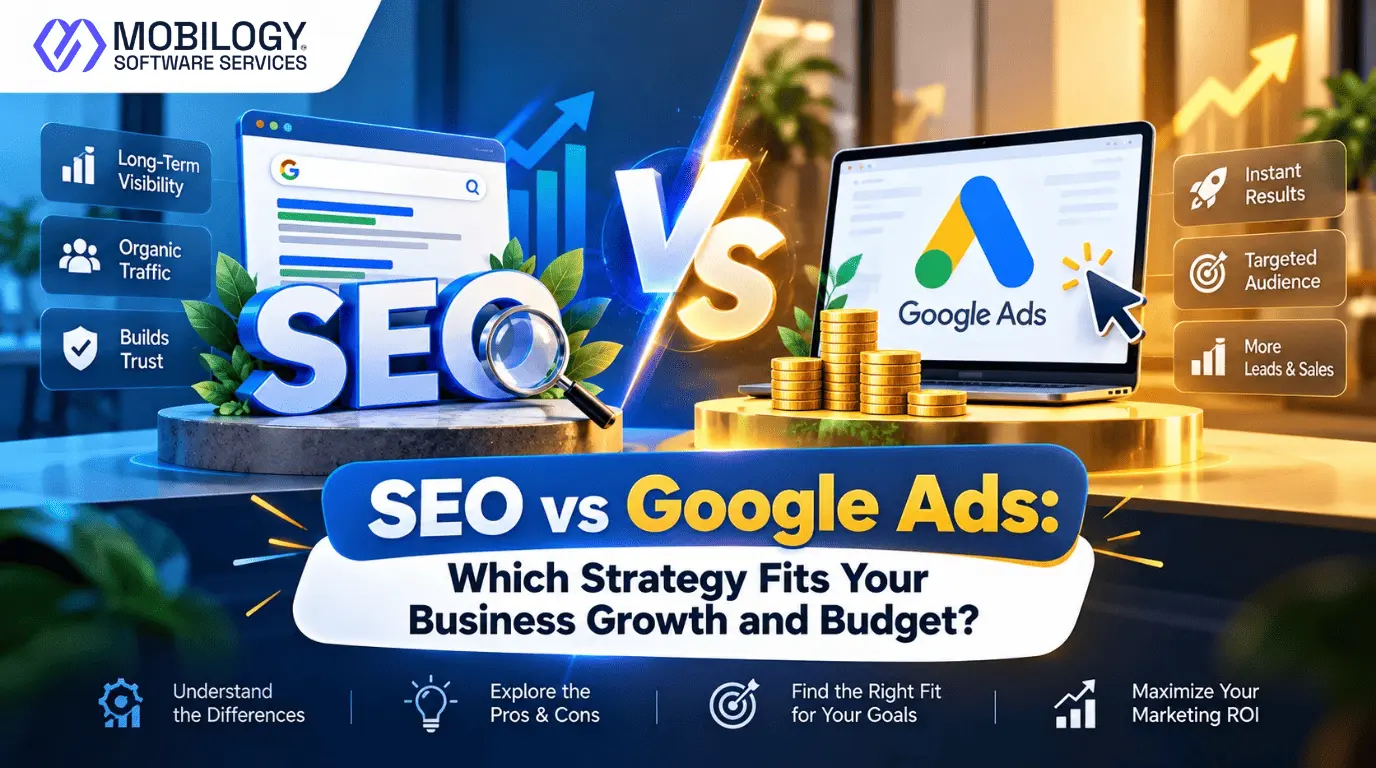
Choosing between SEO vs Google Ads is an important decision for businesses that want to increase website traffic, generate qualified leads, and improve online sales. Both strategies help businesses reach potential customers through Google, but they work differently, require different investments, and support different business objectives.
Search Engine Optimization (SEO) helps your website improve its visibility in organic search results over time. Google Ads allows businesses to pay for advertising placements and reach people searching for relevant products or services. The right option depends on your budget, competition, target audience, sales cycle, and expectations for growth.
For businesses in Ahmedabad, Gujarat, and across India, the decision is not simply about choosing the cheaper option. It is about understanding which channel can deliver the right customers at the right time and how marketing investment can support sustainable business growth.
In this guide, Mobilogy Software Services LLP explains the differences between SEO and Google Ads, their costs, lead generation potential, advantages, limitations, and the situations in which combining both strategies may be the most practical approach.
What Is SEO and How Does It Support Business Growth?
Search Engine Optimization (SEO) is the process of improving a website so that search engines can understand its content and present relevant pages in organic search results. It includes technical improvements, useful content, keyword research, website structure, internal linking, and efforts to build credibility.
SEO aims to attract people who are actively searching for information, services, or products related to your business.
For example, a business owner searching for a digital marketing company in Ahmedabad may discover a service page or helpful article that answers their requirements. If the page is relevant, trustworthy, and easy to navigate, the visitor may contact the business for a consultation.
Key Benefits of SEO
- Long-term organic visibility: Well-optimized pages can continue attracting relevant visitors after publication, although rankings and traffic can fluctuate.
- Relevant website traffic: Targeting specific search intent helps attract users who are looking for your products or services.
- Content-driven trust: Helpful guides, service pages, case studies, and FAQs can demonstrate your expertise.
- Support for local discovery: Local SEO can help eligible businesses appear in relevant local search results and Google Maps.
- Improved website experience: Technical SEO improvements can support crawling, navigation, accessibility, and page usability.
- Compounding value: A strong library of useful content and well-optimized landing pages can support multiple customer journeys over time.
However, SEO is not an instant solution. Competition, website condition, content quality, and the authority of competing pages can influence how quickly improvements become visible. Businesses need a consistent strategy and realistic expectations.
What Is Google Ads and How Does It Work?
Google Ads is Google’s online advertising platform. Businesses can create campaigns to reach potential customers through paid placements, including eligible Search, Display, Shopping, YouTube, and other campaign inventory.
For businesses focused on enquiries, Search campaigns can be especially useful because ads may appear when people search for relevant products or services. Advertisers generally pay according to the campaign’s bidding and billing model; many Search campaigns use a cost-per-click model.
For example, a company offering web development services may run a campaign targeting users searching for website redesign services. The ad can direct visitors to a dedicated landing page with service details, portfolio examples, and a contact form.
Key Benefits of Google Ads
- Faster campaign visibility: Eligible ads can begin appearing after setup, review, and approval, subject to targeting, budget, bidding, and competition.
- Budget flexibility: Advertisers can set campaign budgets and adjust spending as results become clearer.
- Precise targeting: Campaigns can be configured around keywords, locations, audiences, devices, and other available settings.
- Measurable performance: Conversion tracking can help measure enquiries, calls, purchases, and other valuable actions.
- Testing opportunities: Businesses can test offers, messaging, landing pages, and keyword themes.
- Scalable campaigns: Spending can be increased or reduced based on performance and business capacity.
Google Ads also has limitations. Competitive keywords can be expensive, clicks do not guarantee enquiries, and performance can decline if campaigns are poorly targeted or landing pages fail to meet user expectations. Traffic often decreases when campaigns stop, unless other channels continue attracting visitors.
SEO vs Google Ads: Key Differences at a Glance
Understanding the differences between organic SEO and paid search advertising makes it easier to decide where your marketing budget should go.
| Comparison factor | SEO | Google Ads |
|---|---|---|
| Visibility | Organic search results | Paid advertising placements |
| Initial results | Usually takes time | Can begin after campaign approval |
| Cost structure | SEO work, content, technical improvements, and ongoing management | Advertising spend plus any management fees |
| Traffic duration | Can continue while pages remain visible and relevant | Depends on active campaigns and available budget |
| Targeting | Search intent, content relevance, and local optimization | Keywords, locations, audiences, bidding, and campaign settings |
| Best suited for | Long-term organic visibility and sustainable discovery | Targeted campaigns, promotions, and demand capture |
| Performance measurement | Rankings, organic traffic, enquiries, conversions, and revenue | Clicks, cost per click, conversions, cost per lead, and revenue |
| Main challenge | Competition and the time required to build visibility | Ongoing costs and the need to optimize campaigns |
Neither approach guarantees sales. Results depend on the market, offer, website experience, competition, and how effectively visitors are converted into customers. Google also recommends choosing campaign metrics based on business goals and tracking meaningful conversions rather than clicks alone.
SEO vs Google Ads Cost: Which Offers Better Value?
The cost of digital marketing should be evaluated against business outcomes, not just the initial amount spent.
With SEO, businesses may invest in keyword research, technical website improvements, content creation, local SEO, and ongoing optimization. These activities can improve organic visibility over time, but they require resources before meaningful returns may appear.
With Google Ads, businesses control their advertising budget, but the actual cost depends on factors such as keyword competition, bidding, location, campaign type, and conversion performance. Search advertising often charges for clicks, and those clicks do not automatically become customers.
Consider a business that spends money on Google Ads but sends every visitor to a general homepage. Even if the campaign attracts relevant traffic, visitors may leave because they cannot find the specific service, pricing information, or contact details they need.
An SEO campaign can face a similar problem if its pages attract visitors who are not ready to buy.
How to Evaluate Your Marketing Investment
Before selecting a strategy, consider these questions:
- What is the maximum amount you can invest each month?
- How much revenue does an average new customer generate?
- What is the profit margin on your products or services?
- How many qualified enquiries can your sales team handle?
- How long does it normally take to convert an enquiry into a customer?
- Can you wait for organic visibility to develop, or do you need leads sooner?
Important: SEO is not automatically free, and Google Ads is not automatically expensive. The better investment is the one that attracts suitable customers at a cost your business can sustain.
Which Strategy Is Better for Lead Generation?
The answer depends on how quickly you need enquiries and how customers search for your services.
When SEO Is a Better Choice
SEO can be a strong option when your business wants to build consistent visibility for service-related searches. It is particularly useful for companies with multiple services, educational content opportunities, and a long-term growth plan.
For example, an Ahmedabad-based web development company could optimize pages for website redesign, ecommerce development, and business website development. Each page can address a different customer need and provide a clear way to request a consultation.
SEO may be suitable if your business wants to:
- Attract organic enquiries over the long term.
- Build visibility for several service categories.
- Answer customer questions before they contact your company.
- Improve local search discovery.
- Develop website content that supports different stages of the buying journey.
When Google Ads Is a Better Choice
Google Ads may be more appropriate when you need to promote a specific service, test demand, or reach people actively searching for an immediate solution.
For instance, a company launching a new service could use a targeted Search campaign to reach relevant prospects while its organic visibility develops.
Google Ads can be useful when you want to:
- Promote a seasonal offer or time-sensitive service.
- Test which search terms attract qualified leads.
- Generate targeted traffic to a dedicated landing page.
- Reach customers in selected cities or service areas.
- Measure the cost of enquiries and sales from paid campaigns.
The key is to measure qualified leads, customer acquisition cost, and sales revenue. A campaign generating many inexpensive clicks may be less valuable than one producing fewer but more relevant enquiries.
SEO vs Google Ads for Small Businesses in Ahmedabad
Small businesses often need to balance marketing investment with operational costs. For a business in Ahmedabad, the right strategy will depend on its industry, service area, competition, and customer acquisition goals.
A local service provider may benefit from optimizing its website and Google Business Profile while using paid search to promote high-priority services. An ecommerce business may need a different balance, with product-focused campaigns and SEO for category pages, product information, and buying guides.
Here is a practical starting point:
- New business with limited organic visibility: Consider a carefully budgeted Google Ads test alongside essential SEO improvements.
- Established business seeking sustainable enquiries: Invest in SEO while using paid campaigns for selected high-intent searches.
- Business with seasonal demand: Use Google Ads to support time-sensitive offers and maintain SEO for ongoing discovery.
- Business operating in a competitive market: Evaluate both channels using lead quality, conversion rates, and customer acquisition cost.
- Business with a low conversion rate: Improve landing pages, messaging, and enquiry processes before increasing advertising spend.
Local keywords such as SEO services in Ahmedabad, digital marketing company in Ahmedabad, and Google Ads management services in Ahmedabad can help businesses describe their needs more specifically. Choose keywords based on relevance and search intent rather than adding city names to every page.
Can You Use SEO and Google Ads Together?
Yes. For many businesses, SEO and Google Ads work best as complementary marketing channels rather than competing alternatives.
SEO supports organic discovery, while paid campaigns can provide additional visibility for selected searches and offers. Together, the two channels can help businesses reach potential customers through different routes.
A combined strategy may include:
- Use Google Ads to test demand: Identify which keyword themes and offers attract relevant visitors.
- Use SEO to develop useful pages: Build service pages and resources around genuine customer needs.
- Improve landing pages: Apply insights from paid campaign performance to strengthen page relevance and calls to action.
- Track conversions consistently: Measure form submissions, qualified calls, purchases, and other meaningful actions.
- Review search demand: Use available search and campaign insights to identify new opportunities.
- Allocate budgets based on results: Invest more where performance and profitability support it, rather than dividing spending equally by default.
Google continues to develop AI-assisted advertising and measurement capabilities. Businesses should still ensure that conversion tracking, campaign settings, and business goals are configured correctly before relying on automated optimization.
A combined strategy does not mean every business must run paid ads indefinitely. Start with a clear objective, measure the results, and adjust the channel mix according to evidence.
How to Measure SEO and Google Ads Performance
Marketing performance should be measured by the value it generates for your business, not by traffic volume alone.
SEO Metrics to Monitor
- Organic clicks and impressions: Understand how often your pages appear and attract visits from organic search.
- Keyword visibility: Track priority search terms and relevant landing pages.
- Qualified organic leads: Measure how many visitors become genuine enquiries.
- Organic conversion rate: Calculate the percentage of organic visitors who complete a valuable action.
- Engagement and landing-page performance: Identify pages that help users move toward a decision.
- Revenue and customer value: Where possible, connect organic traffic with sales outcomes.
Google Search Console can help you evaluate search visibility and organic clicks. Analytics and CRM data can provide additional context about visitor behaviour and lead quality.
Google Ads Metrics to Monitor
- Cost per click (CPC): The average amount paid for a click.
- Click-through rate (CTR): The percentage of impressions that result in clicks.
- Conversion rate: The percentage of relevant ad interactions that lead to a tracked conversion.
- Cost per lead (CPL): Advertising cost divided by the number of leads generated.
- Customer acquisition cost (CAC): The total relevant cost of acquiring a customer, including the costs you choose to include in your calculation.
- Return on ad spend (ROAS): Attributed revenue divided by advertising spend, where reliable revenue tracking is available.
These metrics serve different purposes. A low CPC does not necessarily mean a campaign is profitable, and a high organic ranking does not guarantee enquiries. Use consistent tracking and compare performance against your actual business objectives.
Common Mistakes to Avoid When Choosing SEO or Google Ads
Businesses can waste time and money when they choose a channel without a clear plan.
Avoid these common mistakes:
- Expecting instant SEO results: Organic visibility generally requires ongoing work and cannot be guaranteed.
- Running ads without conversion tracking: Clicks alone do not show whether the campaign is producing business results.
- Targeting overly broad keywords: Broad targeting may attract visitors who are unlikely to become customers.
- Sending every visitor to the homepage: Use relevant service or product landing pages whenever appropriate.
- Ignoring lead quality: Evaluate whether enquiries match your target customer profile.
- Choosing a channel based only on price: Consider conversion rates, profit margins, customer value, and the time required to see results.
- Stopping optimization too early: Review performance using enough reliable data to make sensible decisions.
- Using duplicate or unhelpful content for SEO: Create pages that answer real customer questions and provide distinct value.
A clear strategy helps prevent these issues and gives your business a stronger foundation for sustainable digital growth.
How Mobilogy Software Services LLP Can Help
Mobilogy Software Services LLP, based in Ahmedabad, Gujarat, India, helps businesses strengthen their online presence through digital marketing services tailored to their objectives.
Our services include:
- Search Engine Optimization (SEO): Improve website structure, content relevance, technical accessibility, and organic search visibility.
- Google Ads Management: Plan and optimize paid campaigns around suitable keywords, audiences, locations, and conversion goals.
- Local SEO: Improve local discovery through relevant website content and Google Business Profile optimization.
- Website Design and Development: Create user-friendly websites and landing pages that support enquiries and conversions.
- Content Writing: Develop useful website content that answers customer questions and supports search intent.
- Digital Marketing Strategy: Coordinate channels according to your budget, target audience, and business goals.
Whether your priority is SEO for long-term growth, Google Ads for targeted traffic, or a combination of both, the first step is to understand your current website performance and customer acquisition goals.
Visit www.mobilogy.in to learn more about our digital marketing services.
Frequently Asked Questions (FAQs)
1. Is SEO better than Google Ads for small businesses?
SEO can support long-term organic visibility, while Google Ads can help businesses reach relevant searchers through paid campaigns. The better choice depends on budget, competition, urgency, and business goals. Many small businesses benefit from combining essential SEO work with carefully controlled advertising.
2. How long does SEO take to show results compared with Google Ads?
Google Ads can begin generating impressions and clicks after a campaign is approved and eligible to serve, although results are not guaranteed. SEO usually takes longer because improvements depend on competition, website quality, content relevance, and search engine processing. Neither channel guarantees a specific number of leads or sales.
3. Is Google Ads more expensive than SEO?
There is no universal answer. Google Ads requires advertising spend and may involve management fees. SEO also requires investment in strategy, content, technical improvements, and ongoing work. Compare the total cost with the number and quality of customers each channel generates.
4. Can SEO and Google Ads target the same keywords?
Yes. A business can target similar search themes through organic SEO and paid campaigns. The two channels have different ranking and advertising mechanisms, so visibility in one does not guarantee visibility in the other. Track each channel separately to understand its contribution.
5. Which is better for lead generation: SEO or Google Ads?
Google Ads may be useful when a business needs targeted visibility for high-intent searches, while SEO can build organic visibility over time. Lead quality depends on keyword intent, competition, landing-page relevance, pricing, and the sales process. Measure qualified enquiries and customer acquisition cost to compare them.
6. Should a new website invest in SEO or Google Ads first?
A new website should establish a sound technical foundation, clear service pages, and useful content. If immediate demand testing is important and the budget allows, a focused Google Ads campaign can run alongside those improvements. The choice should reflect the business’s goals and ability to convert incoming traffic.
7. How much should a business spend on SEO and Google Ads?
The budget depends on the industry, competition, target locations, customer value, and business capacity. Start with a defined marketing budget, set measurable objectives, and review qualified leads and sales before increasing investment. There is no single budget that suits every business.
8. Does AI-powered advertising mean SEO is no longer important?
No. AI-assisted advertising can help manage targeting, bidding, and campaign optimization, but businesses still need relevant offerings, useful website content, accurate conversion data, and strong landing pages. SEO remains a separate way to build organic search visibility and help customers discover relevant information.
Final Verdict: SEO vs Google Ads — Which Strategy Fits Your Business?
The choice between SEO vs Google Ads depends on what your business needs most right now.
Choose SEO when you want to develop organic visibility, useful content, and a long-term source of relevant website traffic. Consider Google Ads when you need targeted campaign visibility, want to test demand, or have a specific offer to promote. If your budget and operational capacity allow, combining both can help you balance immediate opportunities with longer-term growth.
For businesses in Ahmedabad and across India, the smartest approach is to define clear objectives, understand customer acquisition costs, improve website conversion paths, and review performance regularly.
Mobilogy Software Services LLP can help you evaluate your website, select suitable digital marketing channels, and develop an SEO and paid advertising strategy aligned with your business goals and budget.
Visit www.mobilogy.in to explore the right digital marketing approach for your business.