AI SEO audit is becoming an important part of modern search optimization as people increasingly use AI-powered search experiences to research products, compare services, and find answers. Businesses now need to understand not only how their websites perform in traditional search results but also how effectively their content can be discovered, understood, and referenced by AI-powered platforms.
For businesses investing in SEO, ChatGPT website visibility, Google AI Overviews optimization, and AI search optimization are useful areas to evaluate alongside traditional rankings, organic traffic, and conversions.
Google’s current guidance emphasizes established SEO fundamentals, technically accessible pages, and valuable, original content. There is no guaranteed formula for appearing in AI-generated answers, and no special markup guarantees inclusion.
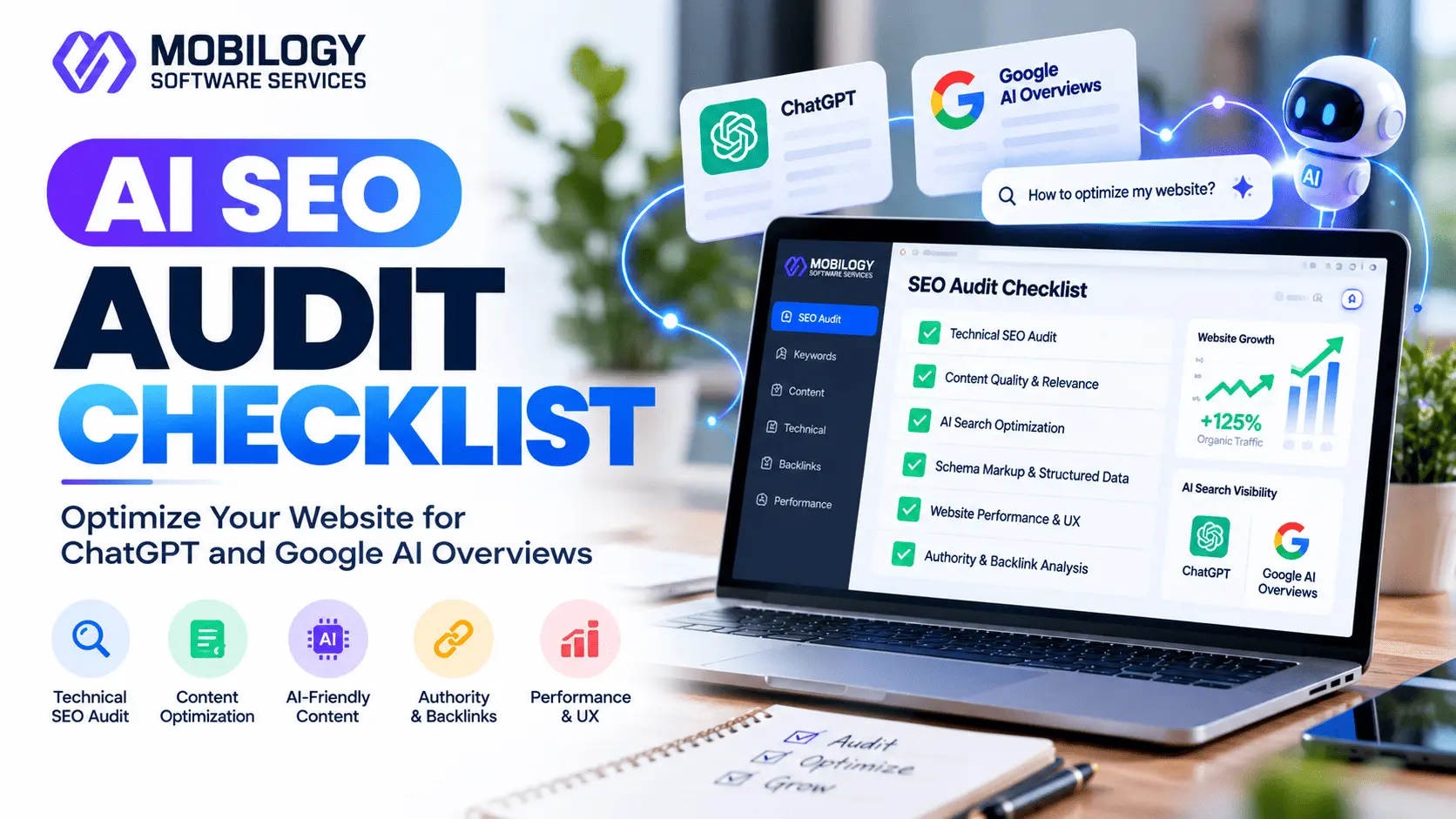
This practical AI SEO Audit Checklist explains how to review your website’s technical health, content quality, business credibility, and search performance to prepare for changing search behavior.
What Is an AI SEO Audit?
An AI SEO audit evaluates whether a website provides accessible, accurate, relevant, and useful information that search engines and AI-powered discovery systems can interpret.
A traditional SEO audit often concentrates on crawling, indexing, keyword rankings, backlinks, page speed, and organic traffic. An AI-focused audit considers these same foundations while also examining how clearly a page answers questions, establishes facts, demonstrates experience, and explains a business’s expertise.
For example, a digital marketing company might rank for a general SEO keyword but still have unclear service descriptions, inconsistent business information, or content that offers little beyond common advice. Reviewing these weaknesses can improve the website’s overall usefulness for prospective customers and its eligibility to appear in relevant search experiences.
An effective audit should assess:
- Technical accessibility and indexability.
- Search intent and content relevance.
- Original information and practical expertise.
- Clear headings, explanations, and supporting evidence.
- Business identity and trust signals.
- Internal links and related topical coverage.
- Visibility, engagement, qualified leads, and conversions.
The objective is not to manipulate AI systems. It is to make your website genuinely useful to people and easier to discover through search.
Why ChatGPT and Google AI Overviews Matter for SEO
People may use traditional Google results, Google AI Overviews, ChatGPT, and other AI assistants at different stages of their research. They might ask for a service comparison, an explanation of a technical problem, or recommendations for a local business.
These experiences can create additional discovery opportunities, but their behavior differs. Google AI Overviews is a feature within Google Search, while ChatGPT is a separate AI product with its own search and retrieval capabilities. Visibility in one does not guarantee visibility in another.
A well-prepared website should therefore provide:
- Clear answers to relevant customer questions.
- Accurate information about its products, services, location, and expertise.
- Original insights that add value beyond competing pages.
- Crawlable, indexable content where appropriate.
- A good mobile experience and clear navigation.
- Consistent information across relevant business profiles and website pages.
Google’s published guidance confirms that established SEO best practices remain important for its AI search features.
AI SEO Audit Checklist: Essential Areas to Review
Use the following checklist as a starting point. Audit important landing pages, service pages, blog posts, and location pages rather than relying on a single homepage review.
| Audit area | What to check | Recommended action |
|---|---|---|
| Technical SEO | Crawlability, indexability, status codes | Fix blocked or unintended non-indexable pages |
| Content quality | Originality, accuracy, completeness | Add expert insight and useful detail |
| Search intent | Whether the page answers the real question | Match content to the visitor’s goal |
| On-page SEO | Titles, headings, descriptive URLs | Make each page’s purpose clear |
| Structured data | Validity and consistency with visible content | Correct errors and misleading markup |
| Internal linking | Connections between related pages | Build logical links to useful resources |
| Brand trust | Contact details, authorship, company information | Make business identity easy to verify |
| Performance tracking | Search visibility, leads, conversions | Measure outcomes and investigate trends |
Use this table as an operational checklist, not a guarantee of AI citations or rankings.
1. Check Technical SEO and Website Accessibility
Before reviewing AI visibility, confirm that search engines can access your important pages. A page with excellent content cannot contribute to organic search visibility if it is blocked from crawling, returns an error, or is unintentionally excluded from indexing.
Technical SEO audit checklist:
- Review your
robots.txtfile for unintended crawling restrictions. - Check important URLs using Google Search Console’s URL Inspection tool.
- Verify canonical tags point to the preferred versions of pages.
- Identify broken internal links, redirect chains, and unnecessary 404 errors.
- Submit an accurate XML sitemap.
- Ensure key information is available as readable text, not exclusively inside images.
- Review JavaScript rendering where content or links depend on client-side scripts.
- Check mobile usability and page performance.
- Confirm that hosting, firewall, or CDN rules do not unintentionally block legitimate crawlers.
For ChatGPT website visibility, remember that different AI products can use different retrieval systems and access rules. Do not assume that every AI platform accesses every page in the same way. Review the official documentation for the particular platform you want to understand.
For Google AI Overviews, Google states that a page must meet the applicable technical requirements for Google Search and be eligible to appear with a snippet. Meeting those requirements does not guarantee inclusion.
2. Audit Content for Originality and Real Value
One of the most important parts of an AI SEO Audit Checklist is evaluating whether your content offers something useful that competing pages do not.
Publishing numerous articles around similar keywords can create the appearance of activity without building meaningful expertise. Rewriting information that already exists across dozens of websites may also leave readers with little reason to choose your page.
Instead, focus on information that helps readers make decisions.
For each important page, ask:
- Does it explain the topic accurately and completely?
- Does it include original analysis, examples, or observations?
- Does it address questions customers genuinely ask?
- Does it explain practical steps, limitations, or trade-offs?
- Are claims supported by reliable sources where appropriate?
- Is the content current enough for the subject?
- Does it provide more value than a generic summary?
- Is the page written for the intended audience rather than just search engines?
For example, a digital marketing agency writing about local SEO could simply list common optimization tips. A more valuable article might explain how to investigate a Google Business Profile visibility problem, distinguish ranking changes from tracking errors, and measure whether leads improve after the changes.
Google recommends valuable, distinctive, people-first content rather than material produced primarily to manipulate search results.
3. Improve Answer Clarity for AI-Powered Search
People often phrase searches as complete questions. They may ask what a service includes, which solution suits their needs, how a process works, or what a particular problem will cost.
Your content should make these answers easy to find without turning every paragraph into a formula designed for AI.
Practical improvements include:
- Use descriptive H2 and H3 headings.
- Introduce the central answer near the beginning of a relevant section.
- Explain technical terminology in plain language.
- Use bullet points for genuinely useful steps or comparisons.
- Include examples that demonstrate how recommendations work.
- Explain exceptions and limitations instead of making absolute claims.
- Add FAQs when they address real customer concerns.
- Keep paragraphs focused and logically connected.
Consider a service page targeting “technical SEO audit services.” A vague opening such as “We provide the best solutions for digital success” tells the reader very little.
A clearer explanation would describe what the audit examines, which technical problems it can identify, what the client receives, and how the findings support SEO improvements.
The aim is clear, complete communication, not artificially shortening every section or breaking content into excessive fragments. Google’s guidance does not require special text chunking or a particular article length for generative AI search.
4. Review Keyword Relevance and Search Intent
Keywords still help organize your SEO strategy, but effective optimization involves more than inserting a target phrase a fixed number of times.
Your AI search optimization process should identify the problems, questions, and decisions connected to each important keyword.
For example, someone searching for an SEO agency in Ahmedabad may be looking for a provider, comparing service packages, checking credibility, or researching pricing. One generic blog post is unlikely to satisfy every intent equally well.
Use this workflow:
- Identify the primary keyword for each important URL.
- Determine whether the search intent is informational, commercial, navigational, or transactional.
- Review the questions and subtopics a visitor needs answered.
- Compare your page with relevant competing results.
- Identify missing information and opportunities for original insights.
- Link to relevant service pages where it helps readers take the next step.
- Review performance and update content when the search intent or information changes.
Avoid creating a separate low-value page for every tiny keyword variation. A focused, comprehensive page is often more useful than multiple near-identical articles competing for the same audience.
5. Strengthen Brand Identity and Trust Signals
AI search optimization is not only about individual paragraphs. Your website should also communicate who your organization is, what it does, whom it serves, and how people can contact it.
For Mobilogy Software Services LLP, this means ensuring the company name, website, service descriptions, and contact information are presented consistently across relevant website pages and business profiles.
Review the following:
- A clear About Us page explaining the business and its services.
- Accurate contact information and an accessible Contact page.
- Detailed service pages with realistic descriptions of deliverables.
- Author or reviewer information where relevant to the subject.
- Genuine client testimonials or case studies, published with appropriate permission.
- Verifiable claims about experience, expertise, or results.
- Consistent business details across relevant online profiles.
- References and evidence for claims that require support.
Do not invent customer reviews, credentials, case studies, or performance statistics to make a brand look authoritative. Trust is strengthened by information that can be verified, not by unsupported promotional language.
Make your business expertise specific
Instead of repeatedly stating that your agency offers “the best SEO services,” explain the work involved:
- Technical SEO issue diagnosis.
- On-page optimization and content improvements.
- Keyword and competitor research.
- Local SEO and Google Business Profile optimization.
- Organic performance reporting and lead analysis.
Specific service information helps prospective clients understand the offering and evaluate whether it meets their needs.
6. Use Structured Data Correctly
Structured data can help search engines interpret information about a page or organization and may support eligibility for certain search enhancements. However, schema markup does not guarantee that ChatGPT or Google AI Overviews will cite your website.
During your audit:
- Check whether relevant
Organization,LocalBusiness,Article, orBreadcrumbListmarkup is appropriate for the page. - Validate the implementation using relevant testing tools.
- Ensure structured data accurately reflects information visible to visitors.
- Keep business names, URLs, dates, and author information consistent.
- Remove obsolete, contradictory, or misleading markup.
- Follow the rules for each specific search feature you intend to support.
Do not add every schema type to every page. Choose markup that accurately describes the content and complies with applicable guidelines.
Google explicitly states that there is no special schema.org markup required for inclusion in its generative AI search features. Continue using structured data as part of a sound overall SEO strategy, not as a shortcut to AI citations.
7. Improve Internal Linking and Topic Relationships
Internal links help visitors navigate your website and help search engines discover the relationships between pages.
A useful AI SEO audit should examine whether your content forms a coherent structure instead of a collection of isolated blog posts.
For example, a digital marketing website could connect:
- A core SEO services page to relevant technical SEO resources.
- A local SEO guide to its Google Business Profile optimization service.
- A content quality article to related content strategy resources.
- An AI search article to relevant SEO audit and analytics pages.
Use descriptive anchor text that tells readers what they will find after clicking. Link to the most relevant destination rather than using the same generic phrase for every link.
Also check for orphan pages—important pages that receive no meaningful internal links—and pages with excessive, repetitive links that make navigation difficult.
Recommended practice: Every important page should have a clear role in your website’s content structure and a logical path for users to reach related information.
8. Review Images, Videos and Multimodal Content
Search experiences increasingly combine different content formats. Images, product visuals, demonstrations, and videos can help visitors understand a topic and may support discovery through relevant search features.
Your audit should check:
- Whether each image serves a clear purpose.
- Whether filenames describe the image accurately.
- Whether meaningful images have useful alternative text.
- Whether image dimensions and file sizes are appropriate.
- Whether videos have clear titles and relevant descriptions.
- Whether important information shown in a graphic is also available as text.
- Whether product or service visuals accurately represent what is offered.
Avoid stuffing alt text with keywords or using generic descriptions for every image. Alternative text should communicate the image’s meaningful content or function.
For a digital marketing agency, a clearly labelled SEO audit screenshot or a genuine, explained performance chart may offer more value than a decorative stock image. Only publish charts and case studies that represent real information.
Google’s guidance for generative AI search continues to emphasize established image, video, and SEO practices rather than a separate set of mandatory AI-specific optimizations.
9. Track AI Search Visibility and Organic Performance
An effective audit needs a measurement plan. Do not judge success only by whether a brand appears in one ChatGPT answer or one Google AI Overview. AI-generated responses can vary by query, context, platform, and time.
Google announced dedicated Search Generative AI performance reporting in Search Console in June 2026, with rollout to all websites worldwide reported by August 31, 2026. Check your Search Console account for the available reporting views and metrics.
Track these performance indicators:
- Organic impressions: How often your pages appear in eligible search results.
- Organic clicks and click-through rate: Whether search visibility attracts visitors.
- Keyword rankings: How your important pages perform for target queries.
- Qualified leads: Whether visitors submit relevant enquiries or contact your business.
- Conversions: Whether organic traffic contributes to meaningful business outcomes.
- AI visibility observations: Whether your brand or content appears in relevant AI answers across repeatable test queries.
- Referral traffic: Whether identifiable visits arrive from AI platforms, where analytics data makes this measurable.
For manual AI visibility checks, create a consistent set of realistic customer questions and record the date, platform, prompt, brand mentions, cited URLs where available, and competitors mentioned. Repeat the checks periodically rather than relying on a single result.
Keep these observations separate from verified analytics data. Not every AI impression, mention, or citation will be measurable through your website analytics.
10. Common AI SEO Audit Mistakes to Avoid
Some tactics sound attractive but can waste time or weaken a website’s quality.
| Mistake | Better approach |
|---|---|
| Publishing large volumes of generic AI articles | Add original research, experience, and useful analysis |
| Repeating keywords unnaturally | Write naturally around search intent |
| Adding schema solely to obtain AI citations | Use accurate markup for its intended purpose |
| Creating unnecessary AI-specific text files | Prioritize crawlability and established SEO practices |
| Buying or manufacturing brand mentions | Build genuine authority through useful work |
| Assuming rankings guarantee AI citations | Monitor each available channel separately |
| Making unsupported expertise claims | Provide verifiable evidence and accurate details |
| Tracking impressions without business outcomes | Measure qualified leads and conversions too |
Google warns against using generative AI to produce many pages without adding value and against tactics intended primarily to manipulate search results. Its guidance also says that files such as llms.txt are not a requirement for visibility in Google’s generative AI search features.
11. Practical AI SEO Audit Action Plan
Use this prioritization framework to turn your findings into an actionable improvement plan.
Priority 1: Fix technical barriers
Check indexing, crawling, canonical tags, broken links, and the availability of important page content.
Priority 2: Improve key pages
Strengthen service pages and high-value articles with original insights, clear answers, reliable evidence, and relevant internal links.
Priority 3: Clarify business credibility
Review company details, contact information, service descriptions, authorship, and genuine proof of expertise.
Priority 4: Measure and refine
Monitor Search Console, analytics, conversions, and repeatable AI visibility checks. Use the results to guide future updates.
The order matters: resolve serious technical problems before spending significant resources on content expansion. Then improve the pages that are most relevant to your customers and business goals.
How Mobilogy Software Services LLP Can Help
Mobilogy Software Services LLP, based in Ahmedabad, Gujarat, India, helps businesses strengthen their online presence through SEO and digital marketing services.
A structured audit can help identify where your website needs attention, whether the issues involve technical accessibility, content quality, search intent, internal linking, or performance measurement.
Our SEO services can support businesses with:
- Technical SEO audits and issue prioritization.
- Keyword research and content strategy.
- On-page SEO and website content improvements.
- Local SEO and Google Business Profile optimization.
- Competitor analysis and organic visibility tracking.
- Website design and development improvements that support usability and search performance.
Visit www.mobilogy.in to learn more about our services.
The objective is to build a website that serves customers effectively, communicates expertise clearly, and follows established SEO best practices. Better AI search visibility may follow, but no agency can guarantee that a particular AI platform will mention or cite a specific website.
Frequently Asked Questions
1. What is an AI SEO audit checklist?
An AI SEO audit checklist is a structured review of technical SEO, content quality, search intent, business credibility, and performance measurement. It helps identify improvements that can support traditional organic search and discovery through AI-powered search experiences.
2. How can I optimize my website for ChatGPT?
Start by publishing accurate, useful content, maintaining accessible pages, providing clear business information, and building a trustworthy website. Review the relevant ChatGPT search and publisher documentation for current access requirements. These steps can improve discoverability, but they do not guarantee that ChatGPT will cite your website.
3. How do I optimize my website for Google AI Overviews?
Follow established Google Search practices: make important pages crawlable and indexable, publish helpful and original content, use appropriate internal links, maintain a good page experience, and ensure structured data matches visible content. Google does not require special AI-specific schema to appear in AI Overviews.
4. Does AI-generated content hurt SEO rankings?
Not automatically. Google’s guidance focuses on content quality and purpose rather than simply whether AI was used. Content created with AI should be accurate, original, useful, and compliant with spam policies. Producing large quantities of low-value pages primarily to manipulate rankings can violate Google’s policies.
5. Is schema markup necessary for AI search optimization?
No special schema markup is required for inclusion in Google AI Overviews. Appropriate structured data can still support eligible search features and help describe page content when implemented correctly. It should not be treated as a guarantee of AI citations.
6. How can I track my website’s visibility in Google AI Overviews?
Review the reporting options available in Google Search Console, along with organic search performance and conversion data. Google introduced dedicated reporting for generative AI search visibility in 2026. Supplement available analytics with consistent manual checks of relevant queries, while recognizing that not every AI appearance is independently measurable.
7. Does llms.txt improve Google AI Overviews rankings?
Google’s current guidance says llms.txt is not required and does not improve visibility in Google’s generative AI search features. Prioritize technical SEO, useful content, and accessible pages before investing in optional AI-specific files.
8. How often should a business perform an AI SEO audit?
Review technical issues and key performance indicators regularly, and conduct a broader audit when launching major website changes, publishing a new content strategy, or investigating unexplained traffic declines. The ideal frequency depends on website size, update frequency, competition, and business goals.
An effective AI SEO Audit Checklist is not about finding a shortcut to ChatGPT citations or Google AI Overviews. It is about understanding whether your website is accessible, informative, trustworthy, and aligned with what customers need.
Prioritize technical health, original content, clear answers, reliable business information, useful internal links, and meaningful performance measurement. These practices support a stronger SEO foundation while helping your business adapt to changing search experiences.
For businesses seeking a structured approach to website optimization, Mobilogy Software Services LLP can help identify improvement opportunities and build an SEO strategy around long-term visibility and qualified leads.