
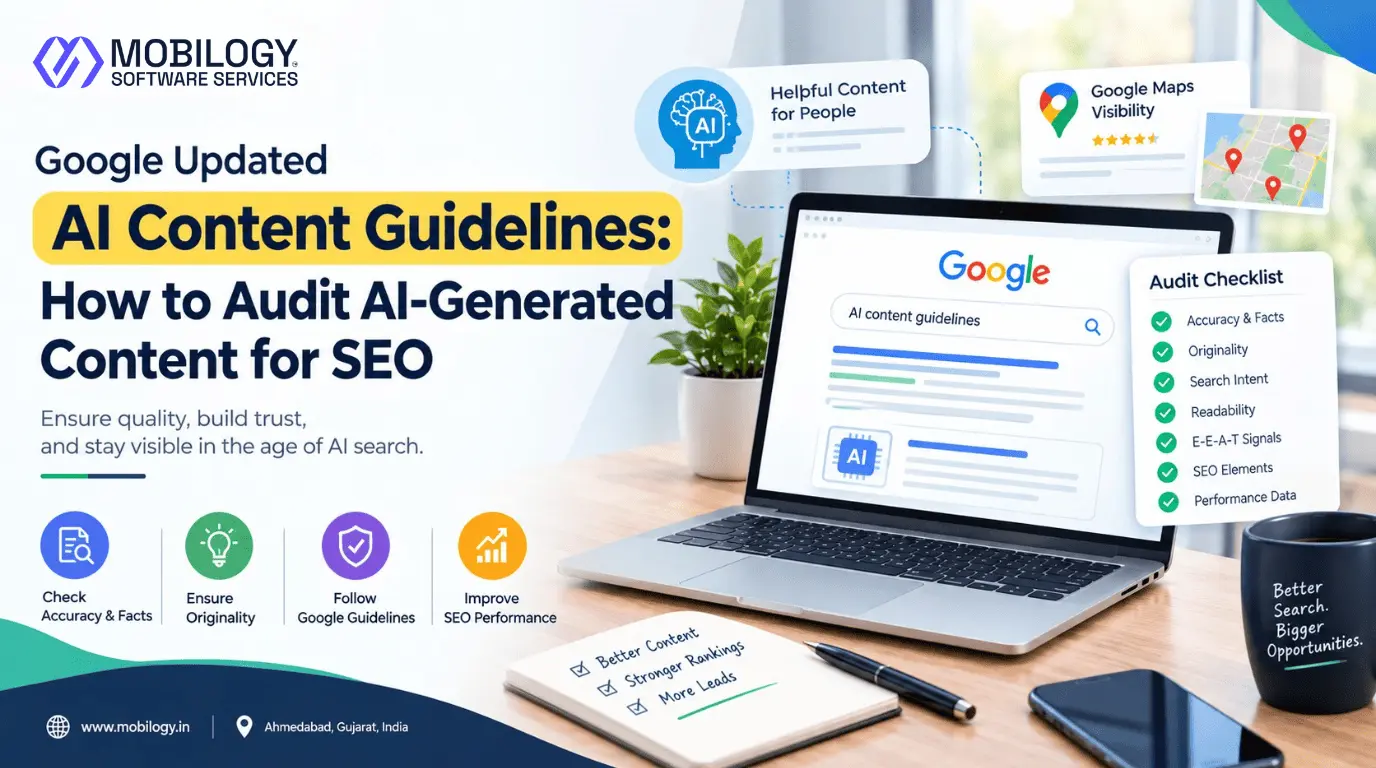
Google AI Content Guidelines explain the importance of creating helpful, reliable, original, and people-first content, whether it is written manually or produced with assistance from artificial intelligence (AI). For businesses using AI writing tools, understanding these guidelines is essential for maintaining content quality, building audience trust, and following Google’s search policies.
AI tools can help marketers research topics, create outlines, draft articles, and improve writing efficiency. However, publishing AI-generated content without fact-checking, editorial review, or meaningful original insights can lead to weak content that fails to satisfy readers.
Google does not automatically penalize content simply because AI was used to create it. The primary concern is whether the content provides genuine value or is produced at scale mainly to manipulate search rankings.
For this reason, businesses should conduct a regular AI content audit for SEO to identify factual errors, repetitive sections, poor search intent alignment, and missing trust signals. A well-planned audit can help improve content quality while supporting sustainable organic search visibility.
At Mobilogy Software Services LLP, based in Ahmedabad, Gujarat, India, we recognize the importance of combining efficient AI-assisted workflows with responsible SEO practices. This guide explains how to review AI-generated content, follow Google’s published guidance, and improve your website content for users and search engines.
1. What Are Google’s AI Content Guidelines?
The Google AI Content Guidelines focus on the quality, usefulness, and purpose of published content rather than the technology used to produce it.
Businesses can use AI for brainstorming, research assistance, outlining, editing, and drafting. However, the finished content should comply with Google’s Search Essentials and applicable spam policies.
Google’s guidance emphasizes helpful information, accuracy, originality, and content created primarily for people. Generating numerous pages with little added value to manipulate search rankings may violate Google’s scaled content abuse policy.
Key principles include:
- Helpful content: Answer genuine questions and provide useful information.
- Accuracy: Verify statistics, facts, technical details, and important claims.
- Originality: Add meaningful insights rather than merely rephrasing existing articles.
- People-first writing: Prioritize readers’ needs over keyword repetition.
- Responsible AI use: Review AI-assisted material before publication.
- Trustworthiness: Use credible references and accurately represent expertise.
Read Google’s official guidance on generative AI content, helpful, reliable, people-first content, and Search spam policies.
2. Why Is an AI Content Audit Important for SEO?
An AI content audit helps website owners assess whether AI-assisted articles are accurate, useful, relevant, and sufficiently original.
AI-generated content can sound professional while containing unsupported claims, repetitive explanations, outdated information, or generic recommendations. These issues may reduce the usefulness of a page even when its grammar and formatting appear correct.
A systematic audit helps businesses:
- Identify factual errors and unverified statements.
- Improve originality and topical relevance.
- Remove unnecessary repetition.
- Align content with search intent.
- Strengthen trust through credible sources and transparent information.
- Improve internal linking and page structure.
- Prioritize pages that need updating, merging, or further improvement.
The goal is not to remove AI from the content process. It is to ensure that AI supports the creation of valuable information instead of replacing essential research, judgment, and editorial responsibility.
3. How to Audit AI-Generated Content for SEO
A. Check facts and verify important claims
AI tools may generate incorrect statistics, inaccurate technical explanations, or references that do not support the information presented.
Before publishing, verify important claims against reliable sources. Confirm dates, product details, business information, statistics, and technical recommendations. Replace unsupported statements with verified information or remove them when they cannot be confirmed.
B. Evaluate originality and unique value
An article should provide something useful beyond common explanations available across competing websites.
Add relevant examples, practical workflows, original analysis, and expert insights where appropriate. Avoid copying competitors’ structures or simply changing the wording of existing material.
Plagiarism-checking tools can help identify overlapping text, but they cannot independently determine whether an article is useful, accurate, or genuinely insightful.
C. Match the content to search intent
Identify the main question behind the target keyword. For example, someone searching for an AI content audit checklist expects clear evaluation steps rather than a lengthy introduction to artificial intelligence.
Use descriptive headings, answer important questions directly, and include related keywords naturally. Google Search Console can help identify queries and pages that deserve closer review.
D. Improve readability and structure
Use short paragraphs, meaningful headings, bullet points, and comparison tables where they help readers understand the information. Remove repetitive sections, vague statements, and unnecessary introductions.
Every section should serve a clear purpose and contribute to the reader’s understanding.
4. AI Content Audit Checklist
| Audit area | What to review | Recommended action |
|---|---|---|
| Accuracy | Facts, statistics, and claims | Verify reliable sources |
| Originality | Repeated or generic information | Add meaningful insights |
| Search intent | Whether the page answers the main question | Improve content relevance |
| Keywords | Natural placement and topical coverage | Avoid keyword stuffing |
| Readability | Paragraph length and clarity | Edit for easy scanning |
| Trust | Sources, bylines, and expertise | Add credible supporting information |
| Metadata | SEO titles and descriptions | Make them relevant and accurate |
| Internal links | Related pages and navigation | Add useful contextual links |
| Structured data | Accuracy of schema markup | Validate against visible content |
| Performance | Search impressions and clicks | Review Search Console data |
5. Strengthen E-E-A-T and Content Trust
E-E-A-T stands for Experience, Expertise, Authoritativeness, and Trustworthiness. It provides a useful framework for evaluating whether content demonstrates appropriate credibility.
Improve trust by using accurate author information, citing reliable sources, including genuine examples, and keeping important information current. Do not invent credentials, customer testimonials, or case studies.
A disclosure about AI assistance may be appropriate when readers would reasonably benefit from understanding how the content was produced. Transparency should serve the reader rather than become a meaningless label on every page.
6. Optimize Content for Google AI Overviews and AI Search
Modern search experiences include AI-generated answers and conversational search features. Businesses should continue applying sound SEO fundamentals while making their content useful, distinctive, and easy to understand.
Recommended practices include:
- Answer specific questions clearly.
- Use descriptive headings.
- Provide supporting evidence and examples.
- Maintain crawlable pages and a logical internal-link structure.
- Keep important information available as accessible text.
- Use images and other media when they improve understanding.
- Monitor available organic search and referral data.
No specific content formula guarantees inclusion in Google AI Overviews or other AI search experiences. Focus on quality rather than attempting to manipulate search results.
7. Review Metadata, Internal Links, and Structured Data
AI-assisted workflows may generate page titles, meta descriptions, image alt text, links, and schema markup. Review each element before publication.
- SEO title: Accurately describe the page and include the primary keyword naturally.
- Meta description: Summarize the page and communicate its value.
- Internal links: Connect readers to relevant pages using descriptive anchor text.
- Image alt text: Describe meaningful images accurately.
- Structured data: Ensure markup reflects visible page content and follows applicable requirements.
Valid structured data can make pages eligible for supported search features, but it does not guarantee enhanced results or higher rankings.
8. Use Google Search Console to Improve Content
Google Search Console helps businesses understand how pages perform in organic search. Review impressions, clicks, click-through rate, average position, and search queries to identify opportunities for improvement.
Investigate pages that receive impressions but few clicks, pages that have experienced sustained performance changes, and pages competing for similar search intent.
Do not assume every traffic decline is caused by AI content quality. Seasonality, competition, search demand, technical problems, and changes in search-result layouts can also affect performance.
Use the data alongside editorial judgment to decide whether a page needs better answers, stronger differentiation, an update, or consolidation with another page.
9. Build a Reliable AI Content Workflow
A repeatable workflow makes quality control easier:
- Define the audience, purpose, and search intent.
- Prepare an outline around genuine user questions.
- Use AI selectively for research assistance, ideas, or drafting.
- Verify facts and references.
- Add original insights and useful examples.
- Edit for clarity, accuracy, and readability.
- Review keywords, metadata, links, and schema.
- Publish only after editorial checks.
- Monitor search performance and user outcomes.
- Update content when facts or user needs change.
This approach helps businesses benefit from AI-assisted efficiency while maintaining strong editorial standards.
10. Common AI Content SEO Mistakes to Avoid
Avoid publishing large numbers of pages without meaningful review, repeating keywords unnaturally, copying competitor content, using fabricated statistics, creating near-duplicate pages, or adding unsupported claims of expertise.
Do not assume AI-generated content is automatically penalized or that AI detectors can reliably measure content quality. Google’s policies focus on the purpose and value of the content, not simply whether an AI tool was involved.
The Google AI Content Guidelines reinforce the importance of helpful, accurate, original, and people-first content. Businesses can use AI to support content creation, but meaningful research, fact-checking, and editorial review remain essential.
A structured AI content audit for SEO helps identify weaknesses, improve relevance, and maintain trustworthy website content. By combining editorial checks with Google Search Console insights, businesses can make better decisions about what to improve, update, or consolidate.
Mobilogy Software Services LLP, based in Ahmedabad, Gujarat, India, helps businesses strengthen their online presence through SEO and digital marketing services.
Visit www.mobilogy.in to learn more about our services and strategies for sustainable search visibility.
Frequently Asked Questions
1. Does Google penalize AI-generated content?
No, not simply because AI was used. Content may violate Google’s policies when it is produced primarily to manipulate rankings or otherwise breaches spam policies.
2. How do I audit AI-generated content for SEO?
Review accuracy, originality, search intent, readability, trustworthiness, keywords, metadata, internal links, and structured data. Use Search Console to investigate relevant performance patterns.
3. Should I disclose that content was created with AI?
Disclosure is not universally required for every use of AI. Consider whether readers would reasonably benefit from knowing how the content was created.
4. Can AI-generated content rank in Google Search?
Yes. AI-assisted content can rank when it meets Google’s policies and provides useful, reliable information. Using AI alone neither guarantees rankings nor automatically causes a penalty.
5. What is scaled content abuse?
Scaled content abuse involves producing many pages primarily to manipulate search rankings rather than help users. It can involve AI, human writing, or a combination of methods.
6. How can I optimize content for Google AI Overviews?
Focus on useful, distinctive information, accurate answers, sound technical SEO, and clear content structure. No technique guarantees inclusion in AI Overviews.
7. Are AI content detectors enough to check SEO quality?
No. AI detectors cannot reliably establish whether content is accurate, original, helpful, or compliant with Google’s policies. Editorial review is still necessary.
8. How often should I audit AI-generated content?
Review content before publication and periodically assess important pages, especially when facts change, performance declines, or multiple pages cover similar topics.