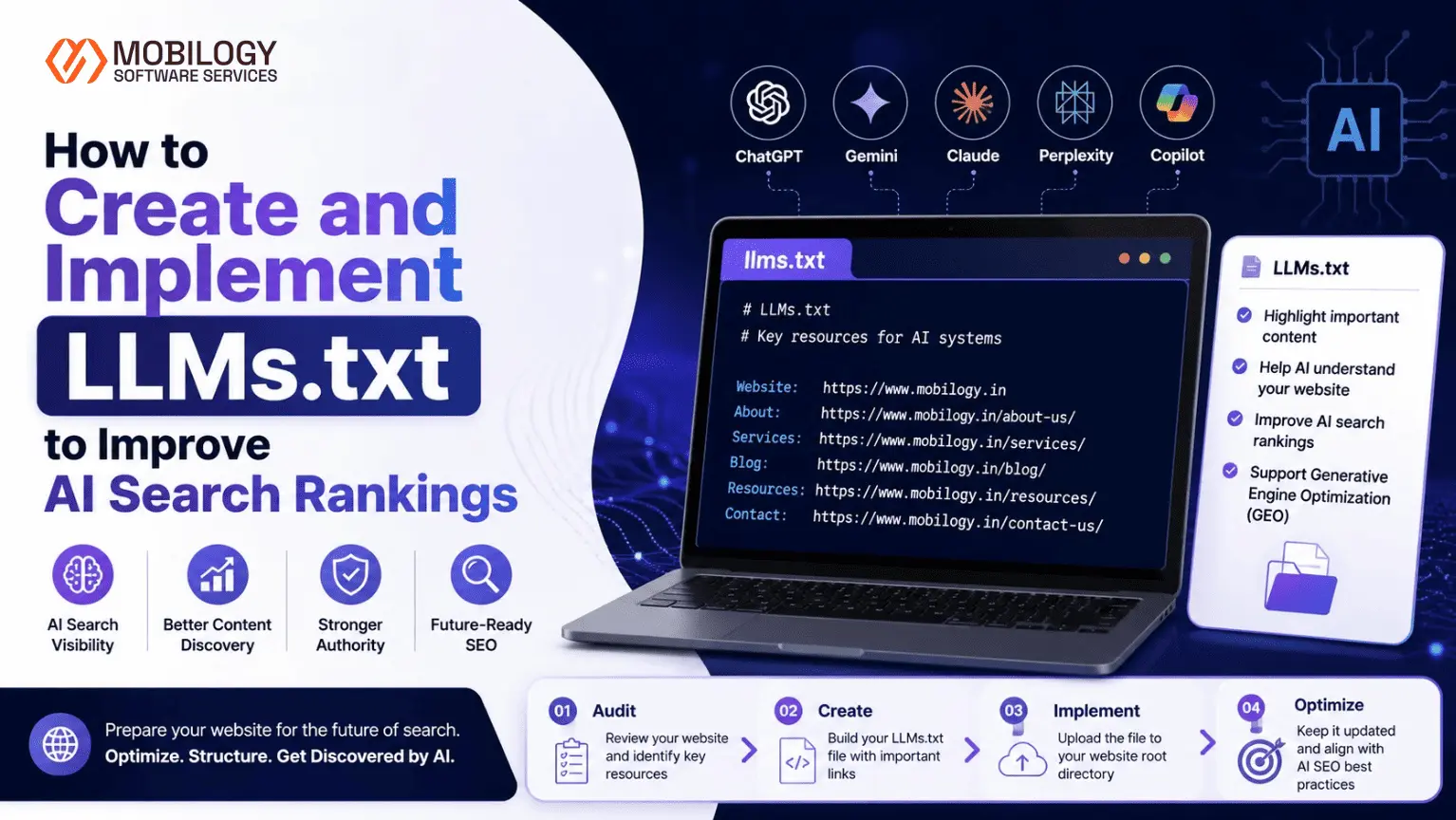
Artificial Intelligence is rapidly changing how people discover information online. Instead of relying solely on traditional search engines, users are increasingly asking AI assistants like ChatGPT, Google Gemini, Claude, Microsoft Copilot, and Perplexity AI for direct answers. As these platforms become a primary source of information, businesses need to adapt their SEO strategies to remain visible. Mobilogy Software Services LLP helps organizations Create and Implement LLMs.txt as part of a future-ready AI SEO strategy that improves content discoverability and supports better AI Search Rankings.
Unlike traditional SEO, which focuses primarily on search engine crawlers, AI search systems analyze trusted websites, understand context, and summarize the most relevant information before presenting responses. This shift has introduced new optimization techniques such as AI SEO, Generative Engine Optimization (GEO), Entity SEO, and LLM SEO, making it essential for businesses to prepare their websites for AI-driven search experiences.
One emerging best practice is to Create and Implement LLMs.txt file, a simple text file that helps Large Language Models identify the most valuable resources on your website. While it is not currently an official web standard, many SEO professionals consider it an effective way to organize important content for AI systems and prepare websites for the next generation of search.
In this comprehensive guide, you’ll learn what LLMs.txt is, why it matters, how to create it correctly, implementation best practices, common mistakes to avoid, and how it supports long-term AI SEO success.
What Is LLMs.txt?
LLMs.txt is a plain text file placed in your website’s root directory that provides guidance to Large Language Models (LLMs) about your website’s most important resources.
Unlike robots.txt, which controls crawler access, or sitemap.xml, which lists website URLs for search engines, LLMs.txt acts as a roadmap for AI systems by highlighting the pages you want AI models to understand and reference.
A well-structured LLMs.txt file can include:
- Homepage
- Service pages
- Product pages
- Documentation
- Knowledge base
- Blog categories
- Tutorials
- Case studies
- Contact page
- About page
Its primary objective is to help AI systems quickly recognize the most valuable and authoritative content on your website.
Why Create and Implement LLMs.txt for AI Search Rankings
As AI-powered search continues to evolve, websites with organized, trustworthy, and structured information are more likely to be understood accurately by AI assistants.
When you Create and Implement LLMs.txt, you can help AI platforms:
- Discover your most valuable content faster
- Understand website structure more efficiently
- Identify authoritative pages
- Support Generative Engine Optimization (GEO)
- Improve topical relevance
- Strengthen AI content understanding
- Enhance overall AI SEO strategy
- Improve long-term AI Search Rankings
Although LLMs.txt does not directly influence Google’s ranking algorithm, it complements your existing SEO efforts by making high-quality content easier for AI systems to interpret.
Difference Between Robots.txt, Sitemap.xml and LLMs.txt
Although these three files work together, each serves a different purpose.
| File | Primary Purpose |
|---|---|
| robots.txt | Controls which pages search engine crawlers can access |
| sitemap.xml | Lists important URLs for search engine indexing |
| LLMs.txt | Highlights valuable content for AI understanding |
Rather than replacing one another, these files work together as part of a modern AI SEO strategy.
Why Businesses Should Start Using LLMs.txt
Businesses investing in AI-ready websites are positioning themselves for the future of search.
Industries that can benefit include:
- Digital Marketing Agencies
- Software Companies
- SaaS Platforms
- Healthcare Organizations
- Manufacturers
- Educational Institutions
- Financial Services
- Legal Firms
- E-commerce Businesses
- B2B Companies
If your website publishes valuable content such as blogs, documentation, service pages, FAQs, tutorials, or knowledge bases, implementing LLMs.txt can improve the organization of your information for AI systems.
Step 1: Audit Your Website Before You Create and Implement LLMs.txt
Before creating your LLMs.txt file, perform a comprehensive content audit to identify the pages that provide the highest value.
Review the following sections carefully:
- Homepage
- Core service pages
- Product pages
- Documentation
- Help Center
- Blog articles
- FAQs
- Case studies
- About page
- Contact page
During the audit, remove or update:
- Duplicate pages
- Thin content
- Broken URLs
- Outdated blog posts
- Expired landing pages
- Low-quality resources
Remember that LLMs.txt should focus on quality rather than quantity. Only include pages that accurately represent your business and provide genuine value to users.
Step 2: Identify Your Most Important Content
Once your audit is complete, decide which pages best represent your expertise and authority.
Ask yourself these questions:
- Which pages generate the most leads?
- Which content demonstrates industry expertise?
- Which pages answer customer questions?
- Which resources remain relevant over time?
- Which pages receive the highest engagement?
Typical high-priority pages include:
- Homepage
- Service pages
- Pricing page
- Product documentation
- API documentation
- Knowledge base
- Tutorials
- Industry guides
- Evergreen blog content
Prioritizing evergreen and authoritative content helps AI systems better understand your website’s core topics and areas of expertise.
Step 3: How to Create and Implement LLMs.txt
After identifying your most valuable content, the next step is to create the LLMs.txt file. This file should be simple, well-organized, and easy for both humans and AI systems to understand. Unlike XML sitemaps, LLMs.txt uses a plain text format that lists your website’s essential resources.
Create a new file named:
llms.txtBelow is an example of a clean structure:
Website:
https://www.example.com/

About:
https://www.example.com/about/

Services:
https://www.example.com/services/

Blog:
https://www.example.com/blog/

Documentation:
https://www.example.com/docs/

Resources:
https://www.example.com/resources/

Contact:
https://www.example.com/contact/
You can also organize larger websites into logical sections such as:
- Core Services
- Products
- Documentation
- Knowledge Base
- Blog Categories
- FAQs
- Case Studies
- Support Center
Keep the formatting consistent and avoid adding unnecessary URLs. A clean structure makes it easier for AI systems to identify your website’s most valuable content.
Step 4: Upload Your LLMs.txt File
Once you’ve created the file, upload it to your website’s root directory.
The file should be publicly accessible at:
https://yourdomain.com/llms.txtFor WordPress websites, you can upload it using:
- cPanel File Manager
- FTP (FileZilla)
- Hosting Control Panel
- SSH Terminal
- Your web hosting file manager
After uploading, open the URL in your browser to verify that the file is accessible.
If your website uses a CDN or caching plugin, clear the cache after uploading to ensure the latest version is served.
Step 5: Keep Your LLMs.txt Updated
Creating the file is only the beginning. As your website grows, your LLMs.txt should evolve alongside it.
Update the file whenever you publish:
- New service pages
- New products
- Important blog articles
- Documentation
- Knowledge base articles
- Tutorials
- Case studies
- Industry guides
Similarly, remove URLs that are:
- Outdated
- Broken
- Redirected
- No longer relevant
Treat LLMs.txt with the same importance as your sitemap.xml by reviewing it regularly.
Best Practices to Create and Implement LLMs.txt
Following best practices helps maximize the usefulness of your LLMs.txt file while keeping it clean and easy to maintain.
Recommended practices include:
- Include only high-value pages.
- Use HTTPS URLs throughout the file.
- Organize content into logical sections.
- Remove duplicate entries.
- Exclude low-quality or thin pages.
- Update the file regularly.
- Keep formatting simple and readable.
- Focus on evergreen content.
- Prioritize authoritative resources.
- Review the file after major website updates.
A well-maintained LLMs.txt file complements your broader AI SEO strategy and improves your website’s organization for AI systems..
Common Mistakes When You Create and Implement LLMs.txt
Many websites make simple mistakes that reduce the effectiveness of their LLMs.txt implementation.
Avoid these common errors:
- Listing every page on the website
- Including duplicate URLs
- Adding broken links
- Using HTTP instead of HTTPS
- Including temporary landing pages
- Forgetting to update the file
- Poor formatting
- Adding low-quality content
- Including redirected pages
- Ignoring content hierarchy
Remember, quality is always more important than quantity. Focus on your most authoritative and helpful resources.
Combine LLMs.txt with AI SEO Best Practices
While LLMs.txt can improve content organization, it should never be treated as a standalone SEO solution.
For the best results, combine it with:
- Structured Data (Schema Markup)
- Technical SEO
- Internal Linking
- Topic Clusters
- Entity SEO
- E-E-A-T (Experience, Expertise, Authoritativeness, Trustworthiness)
- Helpful Content
- Mobile Optimization
- Fast Website Speed
- Core Web Vitals
- Clean URL Structure
- XML Sitemap
- Optimized Robots.txt
These elements work together to improve both traditional SEO performance and AI content discoverability.
Optimize Your Content for AI Search
AI systems prefer content that is accurate, well-structured, and easy to understand.
Improve your content by using:
- Clear headings
- Short paragraphs
- Bullet points
- Tables
- FAQs
- Definitions
- Step-by-step tutorials
- Examples
- Internal links
- Supporting images
In addition, ensure your content demonstrates genuine expertise, cites reliable information where appropriate, and answers users’ questions comprehensively.
Content written for humans while remaining easy for AI systems to interpret performs better over time.
Why LLMs.txt Supports Generative Engine Optimization (GEO)
Generative Engine Optimization (GEO) focuses on making content more understandable and accessible for AI-powered search engines and assistants.
A well-structured LLMs.txt file contributes to GEO by helping AI systems:
- Identify trusted resources
- Understand your website hierarchy
- Discover cornerstone content
- Recognize topical authority
- Access important documentation
- Locate evergreen content
- Improve contextual understanding
Although LLMs.txt alone does not determine rankings, it strengthens your overall AI readiness when combined with high-quality content, technical SEO, and structured data.
AI SEO Checklist Before Publishing LLMs.txt
Before making your file live, verify that your website includes:
- Secure HTTPS website
- Updated sitemap.xml
- Optimized robots.txt
- Mobile-friendly design
- Fast loading speed
- Schema Markup
- Strong internal linking
- Helpful original content
- Clear navigation
- Author information
- Updated contact details
- Optimized title tags and meta descriptions
Completing this checklist ensures your website is well-prepared for both traditional search engines and emerging AI-powered search platforms.
Should Every Website Create and Implement LLMs.txt?
Although LLMs.txt is still an emerging best practice rather than an officially adopted web standard, creating one can be beneficial for websites that publish substantial, high-quality content. As AI-powered search assistants continue to evolve, organizing your website for AI understanding is becoming an important part of a modern SEO strategy.
You should consider creating an LLMs.txt file if your website includes:
- Business websites with multiple service pages
- Digital marketing agency websites
- SaaS platforms
- Software companies
- Documentation portals
- Educational websites
- Healthcare organizations
- Manufacturing businesses
- E-commerce stores
- Financial service providers
- Legal firms
- Knowledge bases
- Blogs with evergreen content
Smaller brochure-style websites with only a few pages may not see immediate benefits. However, adopting this practice early helps future-proof your website as AI search becomes more sophisticated.
How Mobilogy Software Services LLP Helps Businesses Create and Implement LLMs.txt
At Mobilogy Software Services LLP, we help businesses prepare for the future of AI-powered search by combining traditional SEO with modern AI optimization strategies. Our team understands that ranking well today requires more than optimizing for search engines—it also means making your website easy for AI systems to understand and trust.
Our AI SEO services include:
- LLMs.txt implementation
- AI SEO Consulting
- Generative Engine Optimization (GEO)
- Technical SEO Audits
- Website Architecture Optimization
- Schema Markup Implementation
- Entity SEO
- Internal Linking Strategy
- Content Optimization
- AI Search Readiness Assessment
- Local SEO
- Website Performance Optimization
- Core Web Vitals Improvements
- AI-Friendly Content Strategy
Based in Ahmedabad, Gujarat, India, Mobilogy Software Services LLP works with startups, SMEs, and enterprise businesses to improve visibility across Google Search, Google Maps, ChatGPT, Gemini, Microsoft Copilot, Claude, Perplexity AI, and other emerging AI-powered platforms.
Whether you want to improve your organic search performance or prepare your website for the future of AI search, our experienced SEO specialists can help you build a sustainable and future-ready digital presence.
Frequently Asked Questions (FAQs)
Is LLMs.txt mandatory?
No. LLMs.txt is currently an emerging best practice and is not an official web standard. However, it can help organize important website resources for AI systems and complement your overall AI SEO strategy.
Does LLMs.txt replace robots.txt?
No. These files serve different purposes.
- robots.txt controls crawler access.
- sitemap.xml lists important URLs for indexing.
- LLMs.txt highlights valuable content that AI systems should understand.
They work together rather than replacing one another.
Does Google use LLMs.txt as a ranking factor?
Google has not officially confirmed that LLMs.txt is a ranking signal. However, organizing high-quality content for AI systems aligns with modern SEO best practices and supports broader AI search optimization efforts.
Can creating and implementing LLMs.txt improve AI Search Rankings?
Creating and implementing LLMs.txt alone will not automatically improve rankings. However, when combined with high-quality content, technical SEO, schema markup, strong internal linking, and E-E-A-T principles, it can make your website easier for AI systems to understand and reference.
Where should I place my LLMs.txt file?
Upload it to your website’s root directory so it is publicly accessible.
Example:
https://yourdomain.com/llms.txtAlways verify that the file opens correctly in a web browser after uploading.
How often should I update LLMs.txt?
Review and update your LLMs.txt whenever you:
- Publish new service pages
- Launch new products
- Add documentation
- Publish important blog articles
- Create new knowledge-base content
- Remove outdated pages
- Change your website structure
Keeping the file updated ensures AI systems can always find your latest and most valuable content.
Can small businesses benefit from LLMs.txt?
Yes. While larger websites with extensive content libraries often benefit the most, small businesses can also use LLMs.txt to highlight their most important pages and prepare for the growing influence of AI-powered search.
The future of SEO is no longer limited to traditional search engines. AI-powered assistants such as ChatGPT, Google Gemini, Claude, Microsoft Copilot, and Perplexity AI are changing how users discover information, compare services, and make purchasing decisions. Businesses that adapt to this shift today will be better positioned for long-term online visibility.
Learning how to Create and Implement LLMs.txt is an important step toward building an AI-ready website. While the file itself is not a direct ranking factor, it complements your overall AI SEO strategy by helping AI systems identify your most valuable content and understand your website’s structure more effectively.
For the best results, combine LLMs.txt with:
- High-quality, helpful content
- Technical SEO best practices
- Structured Data (Schema Markup)
- Strong internal linking
- Fast page speed
- Mobile-friendly design
- E-E-A-T principles
- Entity SEO
- Regular content updates
Together, these elements strengthen your website’s authority, improve user experience, and prepare your business for the next generation of AI-powered search.
If you’re looking to Create and Implement LLMs.txt correctly and build a future-ready SEO strategy, Mobilogy Software Services LLP can help. Our team specializes in AI SEO, Technical SEO, Generative Engine Optimization (GEO), Local SEO, and website optimization solutions that help businesses increase visibility across both traditional search engines and emerging AI platforms.