
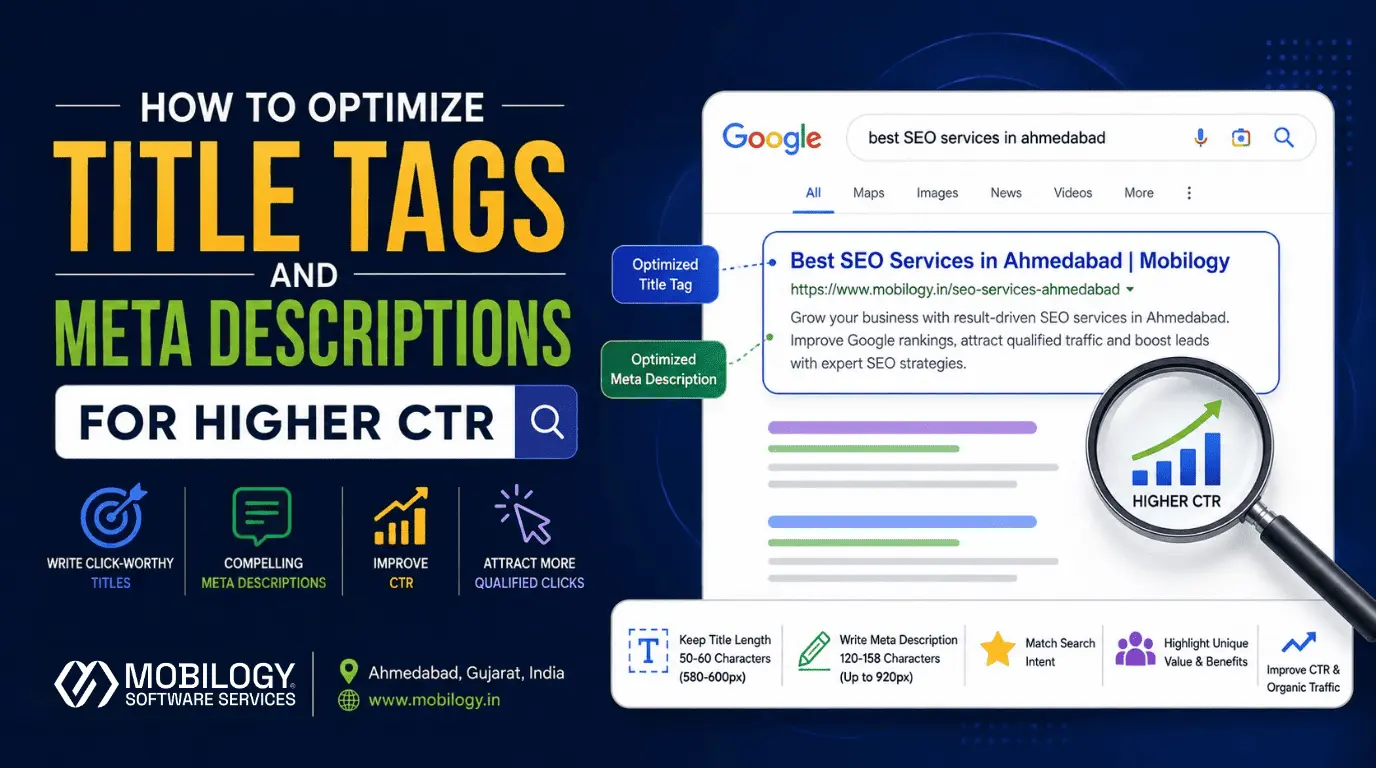
Title tags and meta descriptions play an important role in how your website is presented in Google Search. Even when a webpage has strong rankings and receives thousands of impressions, poor search-result messaging can reduce the number of people who click.
In 2026, title tag optimization is no longer about blindly following a fixed character count. Google does not enforce a strict maximum length for the HTML <title> element. However, longer titles can be truncated in search results depending on available screen width. As a practical SEO target, keeping important title information within approximately 50–60 characters or around 580–600 pixels can help place the most valuable wording where users are likely to see it.
The same principle applies to meta descriptions. Google does not specify a fixed character limit. Search snippets are generated automatically and may be truncated to fit the available display area. For practical optimization, many SEO teams target approximately 120–158 characters, or roughly up to 920 pixels, while making sure the most important information appears early.
For businesses investing in SEO services, content marketing, local SEO, technical SEO, and digital marketing, optimizing these elements can help turn existing search visibility into more qualified website traffic.
At Mobilogy Software Services LLP, Ahmedabad, Gujarat, India, we focus on practical SEO strategies that connect search visibility with user intent, website engagement, leads, and measurable business growth.
What Are Title Tags and Meta Descriptions?
A title tag is the HTML <title> element that describes a webpage. It can influence the title link Google displays in Search and is also commonly shown in the browser tab.
A meta description is an HTML element that provides a concise summary of a webpage. Google may use it to create the search-result snippet when it believes the description provides a useful representation of the page. However, Google can also generate the snippet from visible page content.
A basic example looks like this:
<title>SEO Services in Ahmedabad for Business Growth</title>

<meta name="description" content="Explore SEO strategies that improve search visibility, attract qualified traffic, and help businesses generate sustainable online growth.">
Think of them this way:
Title tag: What is this page about?
Meta description: Why should the user consider clicking this result?
However, neither guarantees a specific ranking position, CTR, or exact wording in Google’s search results.
Why CTR Matters for SEO in 2026
Click-through rate (CTR) represents the percentage of impressions that result in clicks.
For example:
- 10,000 impressions
- 400 clicks
- CTR = 4%
If the same page generates a 5% CTR from the same number of impressions:
- 10,000 impressions
- 500 clicks
- CTR = 5%
That represents 100 additional visits without requiring additional impressions.
This is why organic CTR optimization can be valuable.
However, the goal should not be to attract every possible click.
The real objective is:
Relevant impression → compelling search result → qualified click → useful landing-page experience → conversion
A misleading title might increase clicks temporarily but can result in poor engagement and fewer conversions.
Title Tag Length in 2026: What Is the Right Limit?
This is one of the most misunderstood areas of SEO.
Google does not state that HTML title tags must be 50, 55, or 60 characters. Its official documentation says there is no limit on how long the <title> element can be, but Google may truncate the title link in Search when necessary to fit the device width.
Therefore, 50–60 characters is a practical optimization target, not a Google-enforced rule.
Recommended working range
Title tag:
- Target: 50–60 characters
- Approximate display target: 580–600 pixels
- Put the most important information toward the beginning
- Avoid unnecessary words
- Avoid keyword stuffing
- Keep the title descriptive and unique
Pixel width is important because characters do not all occupy the same amount of horizontal space.
For example, a title containing many wide letters may consume more space than one containing narrower characters.
Therefore:
Character count = useful guideline
Pixel width = closer to actual display behavior
The most important principle is to make the title clear and concise rather than trying to hit an exact number.
Meta Description Length in 2026
Meta descriptions also do not have a fixed Google character limit.
Google explains that there is no limit to how long a meta description can be, but the search snippet may be truncated depending on the available device width.
For practical SEO implementation, a useful target is:
Recommended working range
120–158 characters
with an approximate display target of up to around 920 pixels.
This range can help you create a concise search-result message while reducing the likelihood that important information is pushed too far toward the end.
However, remember:
120–158 characters is an SEO working guideline, not an official Google limit.
Google may choose to display a different snippet based on the search query and page content.
1. Match the Title With Search Intent
The first principle of title tag optimization is understanding what the user wants.
Search intent can include:
- Informational
- Commercial
- Transactional
- Navigational
- Local
- Comparison
- Problem-solving
For example, a user searching:
“SEO services Ahmedabad”
has a different intent from someone searching:
“how to improve website SEO”
The first may be looking for a service provider, while the second is more informational.
Your title should communicate the purpose of the page immediately.
For example:
SEO Services in Ahmedabad for Business Growth
is more specific than:
Digital Marketing Information
Clear relevance can improve the likelihood that the searcher recognizes your page as useful.
2. Place the Primary Keyword Naturally
Your main keyword can be included in the title when it accurately represents the page.
For example:
Primary keyword: Technical SEO Audit
Possible title:
Technical SEO Audit: Complete Website Checklist 2026
This provides:
- Main topic
- Clear purpose
- Current-year relevance
- Concise wording
Avoid turning the title into a list of repeated keywords.
Bad example:
SEO Company Ahmedabad | SEO Services Ahmedabad | SEO Agency Ahmedabad | Best SEO Ahmedabad
This looks unnatural and can reduce the quality of your search-result presentation.
Google specifically recommends avoiding keyword stuffing and unnecessarily repetitive title text.
3. Keep Every Title Unique
Every important webpage should have a title that accurately identifies its specific purpose.
Avoid using the same title for multiple pages.
For example:
SEO Services | Mobilogy
should not be used for every service or blog page.
Instead:
- Local SEO Services for Small Businesses
- Technical SEO Audit Services for Websites
- Google Business Profile Optimization Services
- AI SEO Services for Modern Search
Unique titles help users distinguish between pages.
Google recommends descriptive and distinct title elements rather than repeated boilerplate titles.
4. Put the Most Important Words First
Because search-result display space is limited, front-load important information.
Compare:
Complete Guide for Businesses: How to Improve Organic Search Visibility With Technical SEO in 2026
with:
Technical SEO Guide: Improve Organic Search Visibility in 2026
The second title communicates the primary topic immediately.
A useful structure is:
Primary Topic + Benefit + Specific Detail + Brand
For example:
Local SEO Services in Ahmedabad | Mobilogy
This keeps the important information toward the beginning.
5. Use Numbers When They Improve Clarity
Numbers can make search-result titles more specific.
Examples:
- 10 SEO Mistakes That Can Hurt Website Performance
- 7 Local SEO Strategies for Small Businesses
- 15 Technical SEO Issues to Check in 2026
But don’t add numbers simply to attract clicks.
If an article contains five techniques, don’t call it:
25 Proven SEO Techniques
Accuracy should always come before click appeal.
6. Communicate a Genuine Benefit
A benefit-oriented title can make the result more compelling.
Compare:
Meta Description Optimization Guide
with:
How to Optimize Meta Descriptions for Higher CTR
The second version clearly communicates the expected outcome.
Useful words include:
- Improve
- Increase
- Reduce
- Optimize
- Learn
- Discover
- Guide
- Checklist
- Strategies
- Examples
Avoid exaggerated promises such as:
- Guaranteed #1 Ranking
- 100% Guaranteed Traffic
- Instant Google Rankings
- Secret Google Algorithm Trick
A good SEO title should encourage clicks without misleading users.
7. Write Meta Descriptions Like a Search Result Pitch
A meta description should briefly explain what the user will find on the page.
Weak example:
Learn more about SEO and digital marketing.
Improved example:
Learn how to optimize title tags and meta descriptions, match search intent, improve SERP messaging, and attract qualified organic clicks.
The second version provides more context.
Google describes meta descriptions as short, relevant summaries that can act as a pitch for why a page is useful to the searcher.
8. Put the Main Value Within the First 120–158 Characters
Because we are using 120–158 characters as a practical meta-description target, important information should not be unnecessarily delayed.
For example:
Learn how to optimize title tags and meta descriptions for higher CTR with practical 2026 SEO strategies, examples, and proven optimization tips.
The primary value is communicated immediately.
Avoid beginning with:
“In today’s rapidly changing digital world…”
That consumes valuable space without telling the searcher what the page offers.
9. Remember That Google May Rewrite Your Snippet
A carefully written meta description does not guarantee that Google will display it exactly as written.
Google can generate snippets from the actual content on the page and may use the meta description when it considers it a better representation of the page. Different queries can therefore produce different snippets for the same URL.
This means you should optimize:
Meta description + visible page content + headings + search intent
rather than relying entirely on the description tag.
10. Align Your Title, Description and Page Content
One of the strongest CTR optimization strategies is message consistency.
For example:
Search result
Technical SEO Audit: Complete Website Checklist 2026
Meta description
Find technical SEO problems affecting crawling, indexing, performance, and website visibility with this practical 2026 audit checklist.
Page content
The article actually provides the promised technical SEO audit checklist.
This creates a consistent journey:
Search query → Title → Description → Page → User satisfaction
That consistency is more valuable than using exaggerated clickbait.
11. Optimize Existing Pages With High Impressions
You don’t always need to create new content to increase CTR.
Use Google Search Console to identify pages that have:
- High impressions
- Low CTR
- Relevant search queries
- Reasonable average positions
- Strong content
For example:
50,000 impressions + 1.5% CTR
may represent a significant optimization opportunity.
Review:
- Title
- Meta description
- Search intent
- SERP competitors
- H1
- Page content
- Search queries
Then make a controlled update and monitor performance.
12. Analyze CTR by Search Query
Average page CTR can hide important information.
Consider:
| Search Query | Impressions | CTR |
|---|---|---|
| SEO services Ahmedabad | 8,000 | 3.2% |
| SEO company Ahmedabad | 5,000 | 1.9% |
| local SEO Ahmedabad | 2,500 | 4.8% |
The same webpage can perform differently for different searches.
Therefore, query-level CTR analysis can help identify opportunities to improve title and content relevance.
13. Use Branding Carefully
Branding can help users recognize your website.
For example:
Technical SEO Services in Ahmedabad | Mobilogy
or:
SEO Audit Checklist for 2026 | Mobilogy
But don’t make every title excessively brand-heavy.
Google recommends concise branding and warns against repetitive site-name usage that makes titles unnecessarily repetitive.
14. Avoid the Same Meta Description Across Pages
A common SEO problem is using one description across an entire website.
For example:
Mobilogy provides professional SEO and digital marketing services in Ahmedabad.
That may work for a homepage, but it doesn’t accurately describe every article or service page.
Instead:
Blog page
Learn practical SEO strategies for improving organic visibility, CTR, technical performance, and long-term search growth.
Local SEO service
Improve local search visibility and attract nearby customers with practical Google Business Profile and local SEO strategies.
Technical SEO service
Identify crawling, indexing, canonical, performance, and technical SEO issues with a comprehensive website audit.
Google recommends unique descriptions for individual pages where appropriate.
15. Avoid Keyword Stuffing
Do not turn metadata into a keyword list.
Bad:
SEO services, SEO company, SEO agency, SEO consultant, SEO Ahmedabad, best SEO services Ahmedabad.
Better:
Explore practical SEO strategies that improve search visibility, attract qualified visitors, and support sustainable business growth.
The second version communicates a benefit naturally.
Google specifically advises against keyword stuffing in title elements.
16. Optimize for SERP Competition
Google Search is no longer limited to traditional blue links.
Users may encounter:
- Organic results
- AI-powered Search features
- Featured snippets
- Local results
- Images
- Videos
- News
- Product results
- Discussions
This makes SERP optimization increasingly important.
Your title should quickly communicate:
What is this page about?
Your description should communicate:
Why is this result useful?
Your page should then deliver on that promise.
17. Keep Your H1 Consistent With the Title
Google can use several sources when generating title links, including the <title> element, main visual title, headings such as H1, og:title, prominent page text, anchor text, and other signals.
Therefore, don’t create major inconsistencies.
For example:
Title tag
How to Optimize Title Tags and Meta Descriptions for Higher CTR
H1
How to Improve Website CTR With Better Search Snippets
These aren’t necessarily wrong, but they communicate different topics.
A stronger approach is:
Title
How to Optimize Title Tags and Meta Descriptions for Higher CTR
H1
How to Optimize Title Tags and Meta Descriptions for Higher CTR
Consistency makes the page topic clearer.
18. Optimize the Content Behind the Metadata
Metadata cannot rescue poor content.
If your title promises:
10 SEO Strategies to Improve Organic CTR
the page should actually provide ten useful strategies.
Your webpage should contain:
- Clear H1
- Logical H2 and H3 headings
- Useful explanations
- Original insights
- Relevant examples
- Internal links
- Accurate information
- Strong page experience
- Clear conversion opportunities
Google’s current Search guidance continues to emphasize useful, reliable, people-first content.
19. Use Current Years Carefully
If your content is genuinely updated for 2026, using 2026 in the title can communicate freshness.
For example:
SEO Trends and Strategies for 2026
But don’t automatically add a year to every title.
A page titled:
What Is SEO? 2026 Guide
may become outdated quickly if it is intended as evergreen educational content.
Use a year when:
- Information changes regularly
- Statistics are time-sensitive
- The article is updated annually
- Users specifically search for current information
If you use a year, keep the visible title, title tag, and content consistent.
Google can detect outdated title information and may generate a different title link when the page contains more current information.
20. Test, Measure and Refine
There is no universal title formula that guarantees the highest CTR.
Test different approaches based on:
- Search intent
- Industry
- Audience
- Query type
- Ranking position
- Competition
- Device
- Business objective
Monitor:
- Impressions
- CTR
- Average position
- Organic clicks
- Qualified traffic
- Leads
- Conversions
Don’t change titles repeatedly without allowing sufficient time for Google to recrawl and reprocess the changes. Google notes that changes to title-related sources can take from several days to a few weeks to be noticed.
Practical Title Tag Formula for 2026
A useful framework is:
Primary Keyword + Benefit + Specific Detail + Brand
Example:
Technical SEO Audit: 15 Issues to Fix in 2026 | Mobilogy
Keep the most important words toward the beginning.
Recommended practical target
50–60 characters
Approximately 580–600 pixels
Again, this is a working SEO guideline, not a Google-enforced limit.
Practical Meta Description Formula for 2026
Use:
Topic + Benefit + Supporting Detail + Natural CTA
Example:
Learn how to optimize title tags and meta descriptions for higher CTR with practical SEO strategies, examples, and a 2026 optimization checklist.
Recommended practical target
120–158 characters
Approximately up to 920 pixels
This is a practical target for keeping the description concise, not a fixed Google requirement. Google can generate a different snippet depending on the query and page content.
Title Tag and Meta Description Checklist
Before publishing or updating a page, check:
- Is the title unique?
- Does it accurately describe the page?
- Does it match search intent?
- Is the main keyword naturally included?
- Is the title approximately 50–60 characters where practical?
- Is the important wording near the beginning?
- Is the title approximately within 580–600 pixels where practical?
- Does the title avoid keyword stuffing?
- Is the brand used appropriately?
- Is the meta description unique?
- Is the meta description approximately 120–158 characters?
- Is the important information near the beginning?
- Is the description relevant to the page?
- Does it communicate a genuine benefit?
- Does it match the landing-page content?
- Is the H1 consistent with the page topic?
- Have high-impression, low-CTR pages been reviewed?
- Are clicks, leads, and conversions being measured?
Common Title Tag Mistakes
Avoid:
- Duplicate title tags
- Extremely vague titles
- Keyword stuffing
- Excessive repetition
- Misleading titles
- Unnecessary branding
- Outdated years
- Long boilerplate text
- Titles unrelated to the page
- Multiple competing H1-style headings
Google recommends descriptive, concise title elements and warns against vague, repetitive, keyword-stuffed, or unnecessarily long titles.
Common Meta Description Mistakes
Avoid:
- Duplicate descriptions
- Keyword lists
- Unrelated descriptions
- Unsupported claims
- Excessive repetition
- Very vague descriptions
- Outdated information
- Clickbait
- Descriptions that promise something the page doesn’t provide
Remember that Google may use page content instead of your supplied description when generating the snippet.
FAQs About Title Tags, Meta Descriptions and CTR
1. What is the ideal title tag length in 2026?
There is no official Google character limit for an HTML title tag. Google says title links may be truncated based on available display width. As a practical SEO target, 50–60 characters or approximately 580–600 pixels is a useful working range for keeping important information visible.
2. What is the ideal meta description length in 2026?
Google does not enforce a fixed maximum length for meta descriptions. For practical optimization, a target of 120–158 characters, or approximately up to 920 pixels, can help keep the main message concise. However, Google may generate a different snippet from the page content.
3. Does Google always display my exact title tag?
No. Google automatically generates title links and can use multiple sources, including the HTML title, visible page title, H1, og:title, prominent text, anchor text, and other signals. If Google believes another version better represents the page, it may display different wording.
4. Does a meta description directly improve Google rankings?
A meta description should not be treated as a direct ranking factor. Its main purpose is to provide a useful summary that Google may use in the search snippet and that can help users decide whether to click. Google may also generate the snippet from page content.
5. Can changing a title tag improve CTR?
Yes, improving the relevance, clarity, and value proposition of a title can potentially improve organic CTR. However, results depend on ranking position, search intent, competition, query type, and the quality of the landing page. Changes should be evaluated using Search Console and business-conversion data.
Title tag optimization and meta description optimization remain important parts of modern SEO, but they should not be treated as simple character-count exercises.
The practical approach for 2026 is:
Title tag: Aim for approximately 50–60 characters / 580–600 pixels where practical.
Meta description: Aim for approximately 120–158 characters / up to around 920 pixels where practical.
But the more important principle is clarity and relevance.
Google does not enforce these numbers as hard limits. Search-result presentation depends on device width, query context, page content, and Google’s automated systems.
A strong title should immediately communicate the page’s subject.
A strong meta description should explain the value of visiting the page.
And the webpage itself must deliver on that promise.
For Mobilogy Software Services LLP, Ahmedabad, Gujarat, India, effective SEO services and digital marketing strategies should therefore focus on more than rankings. The objective is to convert search visibility into qualified clicks, engaged visitors, enquiries, leads, and measurable business growth.
When your webpage earns an impression in Google Search, your title and snippet have a valuable job:
Make the relevance clear. Communicate the value. Earn the right click.
That is the foundation of effective CTR optimization in SEO for 2026.

One Comment
Comments are closed.