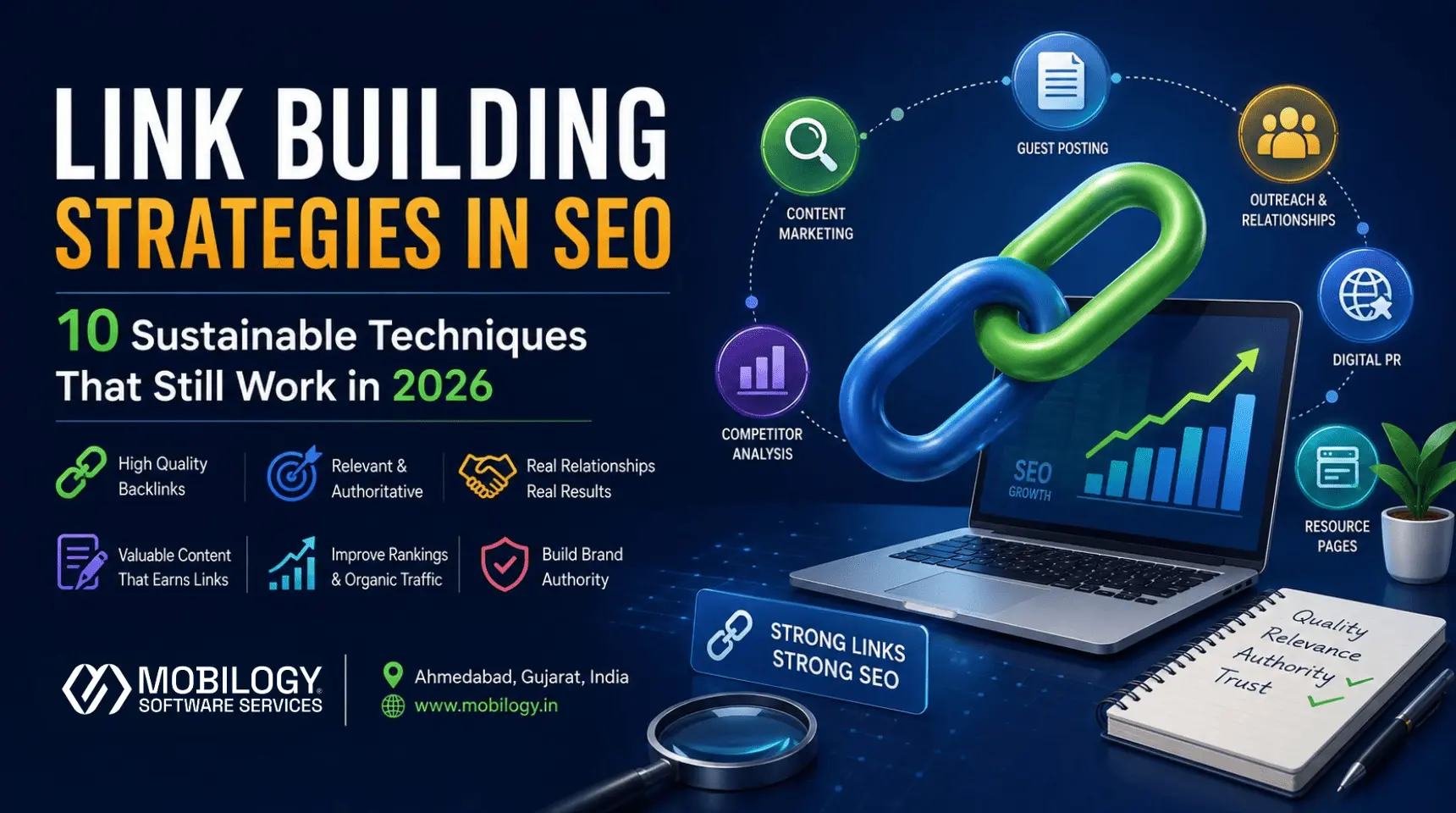
Link building strategies in SEO have changed significantly. In the past, businesses could focus heavily on acquiring a large number of backlinks and expect improved search visibility. In 2026, that approach is increasingly risky and ineffective. Sustainable link building is now more about earning relevant editorial mentions, building relationships, publishing genuinely useful resources, and creating content that other websites have a reason to reference.
Google continues to treat links as an important way to discover pages and understand relationships between resources, but its spam policies explicitly prohibit practices designed primarily to manipulate rankings through links, including buying links for ranking purposes, excessive link exchanges, automated link creation, and low-quality directory links.
For businesses such as Mobilogy Software Services LLP, Ahmedabad, Gujarat, India, the objective should therefore be to build a sustainable SEO link building strategy that supports authority, referral traffic, brand visibility, and long-term organic growth rather than chasing backlink numbers.
What Is Sustainable Link Building?
Sustainable link building is the process of earning relevant, trustworthy backlinks through activities that provide genuine value to publishers, readers, customers, and online communities.
A sustainable backlink strategy typically focuses on:
- Relevance instead of raw backlink volume
- Editorial value instead of paid placement
- Relationships instead of automated outreach
- Original content instead of recycled articles
- Referral traffic instead of rankings alone
- Brand authority instead of artificial link signals
- Long-term resources instead of temporary campaigns
The best backlink is often one that a publisher would naturally include because it improves the usefulness of their content.
Google’s SEO documentation also emphasizes that links can connect users and search engines to relevant resources and help Google discover new pages.
Why Link Building Still Matters in 2026
The SEO environment is changing with AI-powered Search, Google AI Overviews, AI Mode, conversational queries, and increasingly sophisticated search systems.
However, links remain part of the web’s information structure.
A relevant external link can:
- Help users discover your website
- Generate referral traffic
- Introduce your brand to a new audience
- Support relationships with publishers
- Strengthen your digital presence
- Help search engines discover content
- Provide contextual evidence that your resource is useful
The important distinction is that link building should support a useful website rather than compensate for poor content.
Google’s current people-first guidance recommends creating original, useful content that demonstrates expertise and satisfies users rather than producing material primarily to manipulate rankings.
10 Sustainable Link Building Techniques That Still Work in 2026
1. Create Original Data and Research
One of the strongest ways to earn backlinks is to publish information that other websites cannot easily reproduce.
Instead of writing another generic article about your industry, create something based on original research.
Examples include:
- Industry surveys
- Customer research
- Original statistics
- Search trend analysis
- Market reports
- Benchmark studies
- Performance comparisons
- Annual industry reports
- Original datasets
- Expert surveys
For example, a digital marketing company could publish:
“2026 Digital Marketing Trends Among Indian Small Businesses: Survey and Data Report.”
If the research contains useful findings, bloggers, journalists, industry websites, and business publications may reference the report.
This creates an earned media backlink opportunity rather than requiring you to request links from hundreds of websites.
2. Build Linkable Assets
A linkable asset is a useful resource that other websites have a genuine reason to reference.
Examples include:
- Original research
- Free calculators
- Industry checklists
- Templates
- Detailed guides
- Statistics pages
- Interactive tools
- Glossaries
- Research reports
- Case studies
- Original visual resources
Think about the question:
“Why would another website link to this page?”
If the answer is simply “because we asked them,” the asset may not be strong enough.
If the answer is:
“Because this page contains data, tools, or information their audience needs,”
you have a much stronger foundation.
Google’s SEO guidance recommends useful, compelling, unique content and relevant links that provide additional context.
3. Use Digital PR for Earned Backlinks
Digital PR and SEO are increasingly connected.
Instead of sending generic “please give me a backlink” emails, develop stories that journalists, publishers, and industry websites may actually want to cover.
Potential digital PR angles include:
- Original research
- Expert commentary
- Industry predictions
- Local business trends
- Technology developments
- Consumer behavior studies
- Data-driven stories
- Business milestones
- Expert interviews
For an Ahmedabad-based company, local expertise can also create opportunities with regional business publications and industry platforms.
The objective should be:
Create something newsworthy → Pitch the story → Earn coverage → Gain brand visibility and relevant links.
4. Turn Expert Opinions Into Link Opportunities
Expert knowledge can become a valuable digital asset.
Suppose your company specializes in AI-driven SEO services.
You can publish expert analysis on topics such as:
- AI search trends
- Search behavior changes
- SEO measurement
- Digital marketing strategy
- Website performance
- Local business marketing
You can also participate in legitimate expert interviews and industry discussions where your contribution adds genuine value.
The key is to provide real expertise, not a promotional paragraph created solely to obtain a backlink.
This approach aligns with Google’s emphasis on first-hand expertise and original analysis.
5. Reclaim Unlinked Brand Mentions
Sometimes websites mention your company without linking to it.
For example:
“Mobilogy Software Services LLP recently discussed AI SEO strategies…”
but the company name isn’t clickable.
These are potential unlinked brand mentions.
A practical process is:
- Monitor mentions of your brand.
- Identify relevant websites.
- Check whether a link already exists.
- Evaluate whether a link would genuinely help readers.
- Contact the publisher politely.
- Explain which existing mention could be linked.
Don’t demand a backlink.
The request should be based on improving the reader’s experience.
For example:
“Thanks for mentioning our research. If useful for your readers, you may want to link the company name to the original report.”
This is more sustainable than mass outreach.
6. Develop Strategic Industry Relationships
Good relationship-based link building can produce opportunities that last for years.
Build genuine relationships with:
- Industry associations
- Professional communities
- Business networks
- Technology communities
- Local business organizations
- Event organizers
- Industry publications
- Complementary service providers
The relationship should exist independently of the backlink.
Possible outcomes can include:
- Interviews
- Expert contributions
- Event coverage
- Research collaborations
- Co-created content
- Industry reports
- Webinars
- Podcasts
A backlink becomes a natural by-product of the relationship rather than the only reason for it.
7. Publish High-Value Case Studies
Case studies for SEO can attract links while demonstrating expertise.
A strong case study should explain:
- The original business problem
- The situation before implementation
- The strategy used
- Important decisions
- Challenges encountered
- Implementation process
- Measurable outcomes
- Lessons learned
Avoid presenting only vague claims such as:
“Traffic increased significantly.”
Provide meaningful context wherever possible.
For example:
- Organic impressions
- Qualified enquiries
- Conversion rate
- Lead volume
- Search visibility
- Website engagement
A genuinely useful case study can be referenced by industry blogs, business publications, educational resources, and other professionals.
8. Create Local Authority Through Community Participation
For businesses targeting specific locations, local link building can be valuable when it is genuinely connected to the business.
For example, an Ahmedabad company might participate in:
- Local business events
- Industry conferences
- Entrepreneurship programs
- Educational initiatives
- Community projects
- Local technology events
- Business associations
- Professional networking groups
If a legitimate organization publishes an event report or participant page, a relevant mention may naturally include the company’s website.
This is very different from submitting a business to hundreds of low-quality directories.
Google specifically identifies low-quality directory and bookmark links as examples of link spam when used to manipulate rankings.
9. Create Statistics and Reference Pages
A dedicated industry statistics page can become a long-term backlink asset.
For example:
“Digital Marketing Statistics India 2026”
The page could organize information about:
- SEO
- PPC
- Social media
- AI Search
- Content marketing
- Local SEO
- Ecommerce
- Website performance
If properly researched and maintained, statistics pages can attract references from writers creating their own articles.
The important requirement is accuracy.
Don’t publish questionable statistics simply because they contain attractive numbers.
Explain:
- Source
- Date
- Methodology
- Context
- Definitions
This transforms the page from a keyword-targeted article into a useful research resource.
10. Earn Links Through High-Quality Content Promotion
Publishing excellent content is only the first step.
You also need to make the right audience aware that it exists.
A sustainable content promotion strategy can include:
- Email newsletters
- LinkedIn distribution
- Industry communities
- Relevant social platforms
- Expert outreach
- Partner networks
- Customer communities
- Digital PR
- Webinars
- Podcasts
- Industry discussions
The objective isn’t to distribute the same promotional message everywhere.
Instead, adapt the content to each audience.
For example, a research report can be promoted differently to:
- Journalists
- SEO professionals
- Business owners
- Marketing managers
- Industry associations
When people discover something genuinely useful, natural mentions become more likely.
Link Building in 2026: What Should You Avoid?
Sustainable SEO requires knowing what not to do.
Google’s current spam policies identify several link-related practices that can violate its guidelines.
Avoid:
- Buying backlinks specifically to manipulate rankings
- Automated backlink-building software
- Excessive reciprocal linking
- Large-scale link exchanges
- Low-quality directory submissions
- Forum comment link spam
- Hidden links
- Keyword-stuffed links
- Mass guest-post campaigns designed primarily for links
- Sitewide footer backlinks created for SEO
- Private networks created primarily to manipulate rankings
Google also notes that paid advertising and sponsorship links can be legitimate when the links are appropriately qualified, such as with rel="sponsored" or rel="nofollow".
The distinction is important:
Advertising is not the same as buying links to manipulate organic rankings.
How to Evaluate a Backlink Opportunity
Before pursuing a backlink, ask:
Is the website relevant?
A backlink from a closely related industry website can make more sense than one from an unrelated domain.
Does the page have real users?
Look beyond domain metrics.
Consider whether the website appears to have:
- Genuine content
- Real readership
- Active publishing
- Relevant traffic
- A legitimate business or publication purpose
Is the link editorially appropriate?
Would the link make sense to a reader?
Does the page provide value?
Avoid pages created primarily to sell or distribute links.
Could the link generate referral traffic?
A useful referral audience is a strong sign that the placement has value beyond SEO.
Quality vs Quantity in Link Building
A sustainable campaign does not need to produce hundreds of backlinks every month.
Instead, prioritize:
Relevance + Trust + Editorial Context + Referral Value + Sustainability
For example, one highly relevant industry publication that sends qualified visitors may be more valuable to a business than dozens of unrelated low-quality backlinks.
Google’s guidance also makes clear that links should help users and search engines discover relevant resources, rather than exist primarily to manipulate rankings.
How to Build a Sustainable Link Building Workflow
A practical process for 2026 can look like this:
Step 1: Research
Identify industry topics, publisher needs, audience questions, and content gaps.
Step 2: Create
Develop original resources that deserve references.
Step 3: Validate
Check facts, sources, usefulness, originality, and presentation.
Step 4: Promote
Reach the audiences most likely to benefit from the resource.
Step 5: Build Relationships
Connect with publishers, experts, organizations, and communities.
Step 6: Earn Mentions
Allow relevant coverage and editorial references to develop naturally.
Step 7: Monitor
Track referring domains, referral traffic, brand mentions, and links.
Step 8: Maintain
Update important assets and fix broken or outdated resources.
This process creates a long-term link acquisition system rather than a short-term backlink campaign.
How AI Is Changing Link Building in 2026
AI can make SEO workflows more efficient, but it should not turn link building into mass automation.
AI can assist with:
- Research organization
- Prospect categorization
- Content ideation
- Topic clustering
- Outreach personalization drafts
- Brand mention monitoring
- Data analysis
- Competitor research
However, blindly generating thousands of outreach emails or publishing large volumes of low-value content is not a sustainable strategy.
Google’s current spam policies specifically address scaled content created primarily to manipulate rankings, including large amounts of unoriginal content generated with AI or other tools without adding value.
Use AI to improve human productivity—not to replace judgment, originality, and relationships.
Measuring Link Building Success
Don’t evaluate a campaign only by counting backlinks.
Track broader indicators such as:
- New referring domains
- Relevant referring domains
- Referral traffic
- Brand mentions
- Organic visibility
- Leads from referral traffic
- Assisted conversions
- Content engagement
- Publisher relationships
- Links to important commercial pages
- Links to important informational resources
A backlink that generates qualified visitors and brand awareness can be valuable even if its direct ranking impact is difficult to isolate.
FAQs – Link Building Strategies in SEO
1. Is link building still important for SEO in 2026?
Yes. Links remain an important part of how Google discovers pages and understands relationships between resources. However, sustainable SEO link building focuses on relevant, useful, editorially earned links rather than manipulating rankings through large quantities of backlinks.
2. How many backlinks should a website build every month?
There is no universal number. A sustainable campaign should focus on earning relevant links from legitimate websites rather than meeting an artificial monthly backlink target. The quality, relevance, context, and usefulness of the referring website matter more than a predetermined quantity.
3. Are paid backlinks safe for SEO?
Buying or selling links specifically to manipulate organic rankings violates Google’s link spam policies. However, legitimate advertising and sponsorship arrangements can use appropriate rel="sponsored" or rel="nofollow" attributes.
4. Can AI be used for link building?
Yes, AI can assist with research, organization, analysis, prospect qualification, and drafting. However, businesses should avoid using automation to create large volumes of low-value content or spammy outreach. Human review, personalization, originality, and genuine value remain essential.
5. What is the best sustainable link building strategy?
There is no single technique that works for every business. A strong approach combines original research, linkable assets, digital PR, expert contributions, case studies, genuine industry relationships, local participation, useful reference resources, and strategic content promotion.
The future of link building strategies in SEO is not about collecting the largest possible backlink profile. It is about building a digital reputation that naturally attracts references from relevant websites.
In 2026, businesses should prioritize earned backlinks, editorial mentions, digital PR, original research, useful resources, expert insights, and genuine relationships. These approaches can support not only SEO but also referral traffic, brand awareness, credibility, and lead generation.
At Mobilogy Software Services LLP, Ahmedabad, Gujarat, India, we believe sustainable SEO should connect technical optimization with valuable content, real expertise, and measurable business outcomes.
The most useful question is no longer:
“How many backlinks can we build?”
A better question is:
“What can we create that other reputable websites will genuinely want to reference?”
That change in mindset is the foundation of sustainable link building in 2026.
Google’s current guidance reinforces this direction: create people-first content, make links useful and crawlable, and avoid practices designed primarily to manipulate ranking systems.
Build something worth linking to, build relationships worth maintaining, and let SEO value grow from genuine usefulness.