
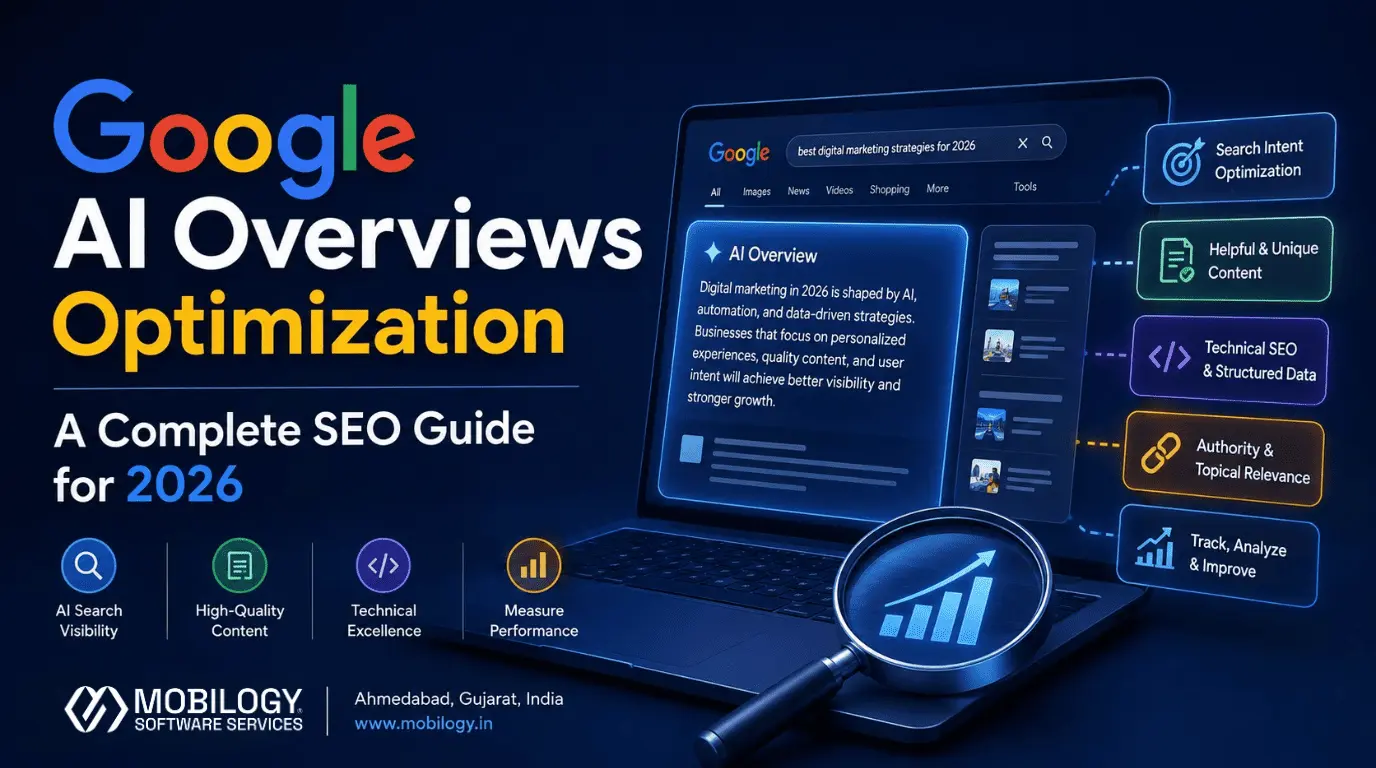
Google AI Overviews optimization has become an important part of modern SEO as Google continues to change how people discover information through AI-powered Search. Instead of displaying only traditional organic listings, Google can now provide an AI-generated summary for certain searches along with links to supporting webpages. This means businesses need to think beyond traditional rankings and create content that is useful, original, technically accessible, and relevant to complex user questions.
Google’s current guidance makes an important point: the fundamentals of SEO still apply to AI Search. Website owners should focus on unique, valuable content, strong page experience, crawlability, accurate structured data, and high-quality multimedia. Google also introduced dedicated Search Console reporting for visibility in generative AI features such as AI Overviews and AI Mode in 2026.
For Mobilogy Software Services LLP, an Ahmedabad-based digital marketing and technology company, understanding AI Overviews SEO can help businesses prepare their content strategy for the changing search landscape.
What Are Google AI Overviews?
Google AI Overviews are AI-generated summaries that can appear within Google Search for eligible queries. They are designed to help users understand a topic quickly while providing links to webpages where they can explore information in greater depth.
This changes the traditional search experience.
Previously, a user might:
- Search for a question.
- Scan several blue-link results.
- Open multiple webpages.
- Compare information.
- Form an answer.
With AI-powered Search, Google may provide a synthesized overview before the user explores supporting sources.
Google says AI Overviews and AI Mode are designed to help people discover websites and provide links into the web. In June 2026, Google reported that AI Overviews had more than 2.5 billion monthly active users, while AI Mode had surpassed one billion monthly active users.
For businesses, this creates a new visibility opportunity—but it also means that traditional ranking position alone is no longer the complete picture of search visibility.
What Is Google AI Overviews Optimization?
Google AI Overviews optimization is the process of improving website content and technical quality so that it can effectively serve users in Google’s AI-powered Search experiences.
There is no official Google formula that guarantees inclusion in an AI Overview.
Therefore, businesses should avoid claims such as:
- “Rank #1 in every AI Overview”
- “Guaranteed AI Overview placement”
- “Get cited by AI in seven days”
- “Use this secret GEO technique to force Google AI to mention your website”
Instead, focus on the factors Google officially emphasizes:
- Unique and useful content
- People-first content
- Technical accessibility
- Strong page experience
- Relevant and accurate information
- High-quality images and video
- Appropriate structured data
- Original insights
- Clear website organization
Google’s guidance specifically states that the same fundamental SEO practices that support traditional Search remain relevant to generative AI features.
Why AI Overviews Matter for SEO in 2026
Search behavior is becoming more conversational and exploratory.
Users can ask longer and more complicated questions, then continue with follow-up questions.
For example, instead of:
a user might search:
“What should a small B2B company in Ahmedabad consider before choosing an SEO agency, and how can it measure whether the investment is generating qualified leads?”
This involves multiple concepts:
- Location
- Business type
- SEO services
- Agency selection
- Investment
- Lead generation
- Measurement
Content that addresses these connected needs can provide more value than a page written around a single keyword.
Google has noted that AI Search experiences are enabling people to ask new and more complex questions.
1. Create Unique, Non-Commodity Content
One of the most important recommendations for AI Overview optimization is to create information that genuinely adds value.
Google’s 2026 guidance specifically emphasizes unique, non-commodity content for success in generative AI Search.
Commodity content is information that can be found almost everywhere with little meaningful difference.
For example, an article saying:
“SEO improves website visibility and traffic.”
provides very little original value.
A stronger article might include:
- Real implementation experience
- Original research
- Industry-specific examples
- Data analysis
- Case studies
- Practical workflows
- Expert observations
- Original screenshots
- First-hand testing
- Clear recommendations
The objective is not simply to make content longer.
The objective is to make it more useful and distinctive.
2. Match Content With Search Intent
Search intent optimization is critical when targeting AI-powered Search.
Before creating a page, identify what the user is actually trying to accomplish.
Common intent categories include:
- Informational
- Commercial investigation
- Transactional
- Navigational
- Comparison
- Problem-solving
- Local intent
A complex query can contain several of these intentions.
For example:
“What is the best SEO strategy for a local business and how much does professional SEO usually cost?”
The user wants:
- An explanation.
- Strategy recommendations.
- Pricing context.
- A potential service decision.
Your content should address the complete information need rather than focusing only on “SEO strategy.”
3. Answer Important Questions Clearly
AI-powered search systems need to understand the subject of a webpage.
Make important answers easy to locate.
A strong content structure can follow this pattern:
Question → Direct Answer → Explanation → Example → Supporting Details
For example:
What Is AI Overview Optimization?
Start with a concise definition.
Then explain:
- Why it matters
- How it relates to SEO
- What businesses should do
- What Google officially recommends
- What businesses should avoid
Clear organization makes content easier for people to consume and easier for search systems to interpret.
4. Build Topical Depth
Do not create a page that mentions a topic superficially.
Build a useful information ecosystem.
For a website discussing AI search optimization, supporting topics might include:
- AI Overviews
- AI Mode
- Search intent
- Conversational queries
- Technical SEO
- Structured data
- Internal linking
- Original content
- E-E-A-T
- Images and video
- Search Console
- Organic traffic
- Conversion measurement
This does not mean placing every term on one page.
Instead, create interconnected resources where each page serves a specific purpose.
5. Strengthen Internal Linking
Internal linking helps users discover related information and helps search engines understand relationships between pages.
For example, an AI Overview article could naturally link to relevant resources about:
- Technical SEO
- Structured data
- Search intent
- Content optimization
- Website performance
- Local SEO
- SEO analytics
Use descriptive anchor text that tells readers what they will find after clicking.
Avoid creating large numbers of links that do not provide genuine value.
6. Make Your Content Technically Accessible
Even excellent content cannot perform effectively if Google cannot properly access, crawl, or index the page.
Google recommends ensuring that pages:
- Can be crawled
- Are accessible to Googlebot
- Return a successful HTTP response
- Contain indexable content
- Are not unintentionally blocked
- Work correctly across devices
These fundamentals apply to AI Search as well as traditional Search.
Review important technical elements such as:
- robots.txt
- XML sitemap
- Canonical tags
- Indexing directives
- HTTP status codes
- JavaScript rendering
- Mobile usability
- Page performance
- Internal links
AI Overview optimization does not replace technical SEO.
It builds on it.
7. Use Structured Data Correctly
Structured data helps search engines understand information on webpages in a machine-readable format.
Depending on the website and content, relevant schema types may include:
- Organization
- LocalBusiness
- Article
- Product
- Service
- BreadcrumbList
However, structured data is not an “AI Overview hack.”
Google recommends that structured data accurately represent the visible content on the page and comply with applicable guidelines.
Never add misleading markup simply because you want to increase search visibility.
8. Demonstrate First-Hand Experience
As AI-generated content becomes easier to produce, first-hand experience becomes increasingly valuable.
Instead of simply explaining what other websites already say, add information based on genuine experience.
Examples include:
- SEO testing
- Website audits
- Campaign observations
- Original case studies
- Before-and-after examples
- Industry-specific recommendations
- Lessons learned from implementation
Google’s people-first content guidance encourages content that demonstrates first-hand expertise and provides original information, research, or analysis.
This is particularly important for businesses publishing professional advice.
9. Optimize Images and Video Too
AI-powered Search is not limited to text.
Google’s guidance recommends supporting textual content with high-quality images and videos, especially as Search becomes more multimodal.
For important webpages:
- Use relevant original images.
- Add descriptive alt text.
- Compress images appropriately.
- Use meaningful filenames.
- Embed useful videos where they add value.
- Provide context around visual content.
- Ensure multimedia works properly on mobile devices.
Do not add images simply to increase the number of visual elements.
Every image should support the user’s understanding.
10. Create Content for Follow-Up Questions
AI-powered search can encourage users to explore a topic through multiple questions.
Therefore, think beyond the initial query.
For example:
Primary question:
How can I optimize my website for AI Overviews?
Possible follow-up questions include:
- Does traditional SEO still matter?
- Does structured data help?
- Should I create longer content?
- How can I improve AI search visibility?
- How can I measure performance?
- Does AI-generated content work?
- How important are backlinks?
- How do I know whether Google is showing my pages?
A comprehensive resource can anticipate these questions naturally.
11. Do Not Rely on AI-Generated Content Alone
AI tools can be useful for research, outlining, editing, and organizing information.
However, publishing large volumes of automatically generated content without meaningful human value is risky.
Google’s guidance states that using generative AI to create many pages without adding value can fall under its spam policies, including scaled content abuse. Google recommends focusing on accuracy, quality, relevance, originality, and user value.
A better workflow is:
AI assistance → Human expertise → Fact checking → Original analysis → Editing → Quality review
The technology can support content production, but it should not replace genuine expertise.
12. Pay Attention to Page Experience
Users who arrive from AI-powered Search still need a good website experience.
Google specifically recommends making pages:
- Easy to navigate
- Mobile-friendly
- Fast enough for users
- Clearly organized
- Free from excessive distractions
- Easy to distinguish between main content and other elements
A visitor who reaches your website from an AI Overview should immediately understand:
What is this page about?
Can I trust this information?
Where can I find the answer?
What should I do next?
13. Think Beyond Clicks
AI-powered Search can change how users interact with search results.
A business should not measure success exclusively through clicks.
Track broader outcomes such as:
- Organic impressions
- Organic clicks
- Search visibility
- Engagement
- Qualified leads
- Form submissions
- Calls
- Purchases
- Sign-ups
- Brand searches
- Assisted conversions
Google has stated that clicks from AI Overviews can be higher quality, with users potentially spending more time on websites after clicking. It recommends considering the broader value of visits rather than focusing only on click volume.
14. Use Google Search Console to Monitor AI Visibility
One of the biggest developments for SEO professionals in 2026 is the introduction of Search Generative AI performance reports in Google Search Console.
Google announced dedicated reporting for visibility within generative AI features such as AI Overviews and AI Mode. The reports can provide information about impressions, pages, countries, devices, and performance over time. Google initially launched these reports to a subset of websites while testing and expanding the functionality.
This changes the way SEO teams can evaluate AI search visibility.
Instead of asking only:
“What is my Google ranking?”
businesses can increasingly ask:
“Which pages are appearing in Google’s generative AI experiences?”
“Which topics generate AI visibility?”
“Which pages are receiving impressions from AI Search?”
“How does AI visibility change over time?”
This creates a more complete AI search performance strategy.
15. Understand What Not to Do
There are many exaggerated AI SEO claims circulating online.
Avoid strategies based on:
- Guaranteed AI Overview rankings
- Keyword stuffing
- Hidden text
- Fake entities
- Mass-produced low-value pages
- Manipulative structured data
- Automated content at scale without human value
- Unverified “AI citation hacks”
- Creating content solely because a topic is trending
Google’s current guidance emphasizes that established SEO fundamentals continue to matter for generative AI Search.
The safest approach is to build a website that would be genuinely useful even if AI Search did not exist.
Google AI Overviews Optimization Checklist for 2026
Before publishing important content, review the following:
- Does the page answer a genuine user need?
- Is the content original and useful?
- Does it demonstrate relevant expertise?
- Is search intent clearly addressed?
- Are important answers easy to find?
- Does the page cover the topic sufficiently?
- Are supporting topics connected naturally?
- Are internal links useful?
- Can Google crawl and index the page?
- Is the page mobile-friendly?
- Is the page experience strong?
- Does structured data accurately match visible content?
- Are images and videos high quality and relevant?
- Is AI-assisted content reviewed by humans?
- Are claims accurate and supported?
- Are conversions and business outcomes being measured?
The Future of AI Overviews and SEO
Google AI Overviews are part of a larger change in how people interact with Search.
Google’s current AI Search experiences increasingly support longer questions, follow-up exploration, multimodal discovery, and links to relevant websites. Google has also introduced features such as Preferred Sources in AI Overviews and AI Mode, while continuing to develop new ways for users to discover information from the web.
This means businesses should not abandon traditional SEO.
Instead, they should strengthen it.
The future-ready approach combines:
- Technical SEO
- People-first content
- Search intent optimization
- Topical authority
- Original research
- First-hand expertise
- Internal linking
- Structured data
- Multimedia optimization
- AI search visibility tracking
- Conversion-focused website optimization
Google itself continues to emphasize that SEO fundamentals remain relevant for success in generative AI Search.
Google AI Overviews optimization is not about finding a secret trick to force your website into Google’s AI-generated answers. It is about creating a website that provides valuable, original, trustworthy information and making that information technically accessible to Search.
In 2026, businesses should think beyond traditional keyword rankings and consider the complete search experience. Users are asking more detailed questions, exploring topics conversationally, and interacting with AI-powered Search in new ways.
The strongest strategy is therefore straightforward:
Create genuinely useful content, demonstrate real expertise, maintain strong technical SEO, structure information clearly, support content with relevant media, and measure how your website performs across evolving Search experiences.
For Mobilogy Software Services LLP, Ahmedabad, Gujarat, India, this approach forms an important part of modern SEO, AI-driven SEO, technical SEO, content marketing, and digital marketing strategies.
AI Search is changing, but the fundamental principle remains the same: help people find reliable answers and make better decisions.
Businesses that build their websites around that principle will be better prepared not only for Google AI Overviews, but for the broader evolution of search in 2026 and beyond.
One Comment
Comments are closed.