
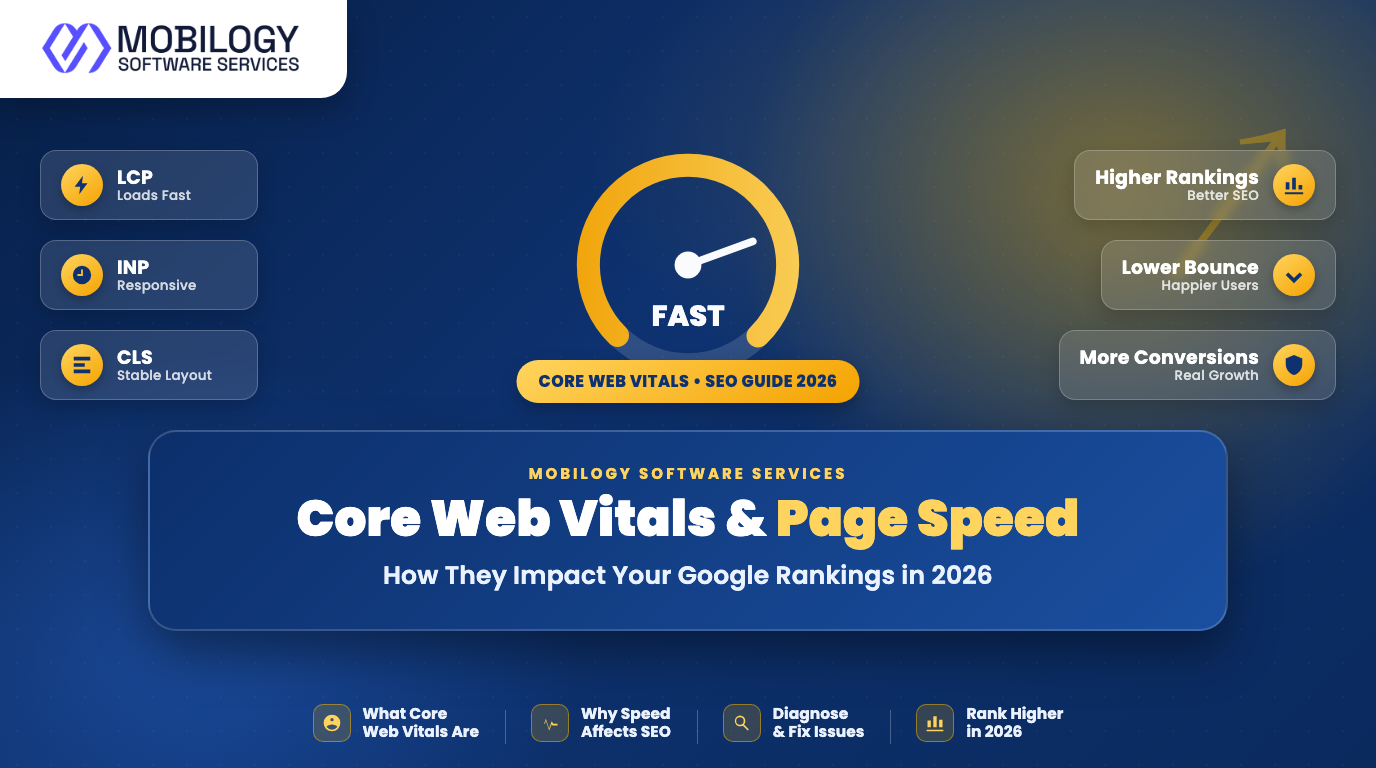
Google has made no secret of it: how fast and stable your website feels to real users is now a ranking factor. That user-experience signal is measured through Core Web Vitals. If your pages are slow to load, sluggish to respond, or jump around while loading, you are quietly losing rankings, traffic, and conversions — especially on mobile.
In this guide, the team at Mobilogy Software Services LLP breaks down what Core Web Vitals are in 2026, why page speed affects SEO, how to diagnose problems, and the practical fixes that move the needle.
What Are Core Web Vitals?
Core Web Vitals are a set of real-world performance metrics Google uses to measure page experience. In 2026 there are three that matter most:
- Largest Contentful Paint (LCP) — how long it takes for the main content to appear. Good: under 2.5 seconds.
- Interaction to Next Paint (INP) — how quickly your page responds when a user taps or clicks. INP replaced First Input Delay (FID). Good: under 200 milliseconds.
- Cumulative Layout Shift (CLS) — how much the page visually jumps around while loading. Good: under 0.1.
Together these answer a simple question Google cares about: is this page a pleasant, trustworthy experience for a real person on a real device?
Why Page Speed Directly Affects Your SEO
There are two ways speed influences your Google rankings — one direct, one indirect.
1. It is a confirmed ranking signal
Core Web Vitals feed into Google’s page experience signals. When two pages are similarly relevant, the faster, more stable one gets the edge — and on competitive keywords, small edges decide page-one positions.
2. It changes user behaviour
Slow pages increase bounce rate, and conversions drop sharply with every extra second of load time. Google watches these engagement patterns, so a poor experience becomes a ranking problem on top of a revenue problem.
This is exactly why speed is a core part of technical SEO, not an optional extra.
How to Diagnose Core Web Vitals Issues
You cannot fix what you do not measure. Use these free tools:
- Google PageSpeed Insights — shows lab and real-world field data for a URL, with specific opportunities.
- Google Search Console → Core Web Vitals report — groups your site into Good, Needs Improvement and Poor URLs based on real users.
- Chrome DevTools (Lighthouse) — great for debugging individual pages during development.
Start with your highest-traffic and highest-value pages, because improvements there have the biggest impact.
Practical Fixes That Improve Core Web Vitals
Improve LCP (make content appear faster)
- Compress and serve images in modern formats like WebP, sized correctly.
- Give your main above-the-fold image
fetchpriority="high"and never lazy-load it. - Remove render-blocking CSS and JavaScript; inline the critical CSS needed for the first view.
- Use quality caching and a CDN so content is served from close to the user.
Improve INP (make the page respond faster)
- Minify and defer non-essential JavaScript so the main thread is free to respond to taps.
- Remove unused scripts and heavy third-party widgets that block interaction.
- Break up long JavaScript tasks so the browser can react to the user quickly.
Improve CLS (stop the page from jumping)
- Always set explicit width and height (or aspect-ratio) on images and embeds.
- Reserve space for ads, banners and dynamically injected content.
- Use
font-display: swapso text stays stable while web fonts load.
Core Web Vitals and Mobile-First Indexing
Google indexes the mobile version of your site first, and most Core Web Vitals problems show up worst on mobile. A page can score well on desktop and still fail on mobile, so always test and optimise for mobile first. See our guide on AI-driven digital marketing and growth.
How Mobilogy Can Help
At Mobilogy Software Services LLP — a top digital marketing company in Ahmedabad — we treat performance as a growth lever, not a vanity score. Our SEO and technical SEO services include full Core Web Vitals audits, image and code optimisation, caching and CDN setup, and ongoing monitoring so your rankings keep climbing.
Want faster pages and higher rankings? Get in touch with our team for a free performance review.
Frequently Asked Questions
Are Core Web Vitals a Google ranking factor in 2026?
Yes. Core Web Vitals are part of Google’s page experience signals and act as a tie-breaker and quality signal, particularly on competitive and mobile searches.
What is a good LCP, INP and CLS score?
Aim for LCP under 2.5 seconds, INP under 200 milliseconds, and CLS under 0.1 — measured on real-world mobile data.
How quickly will improving Core Web Vitals help my rankings?
Field data in Search Console updates over roughly 28 days, so expect a few weeks before improvements are fully reflected, with UX and conversion gains often visible sooner.
Does page speed matter more than content?
No — relevant, high-quality content comes first. But once your content is strong, speed and stability help it outrank equally relevant but slower competitors.



2 Comments
Comments are closed.