
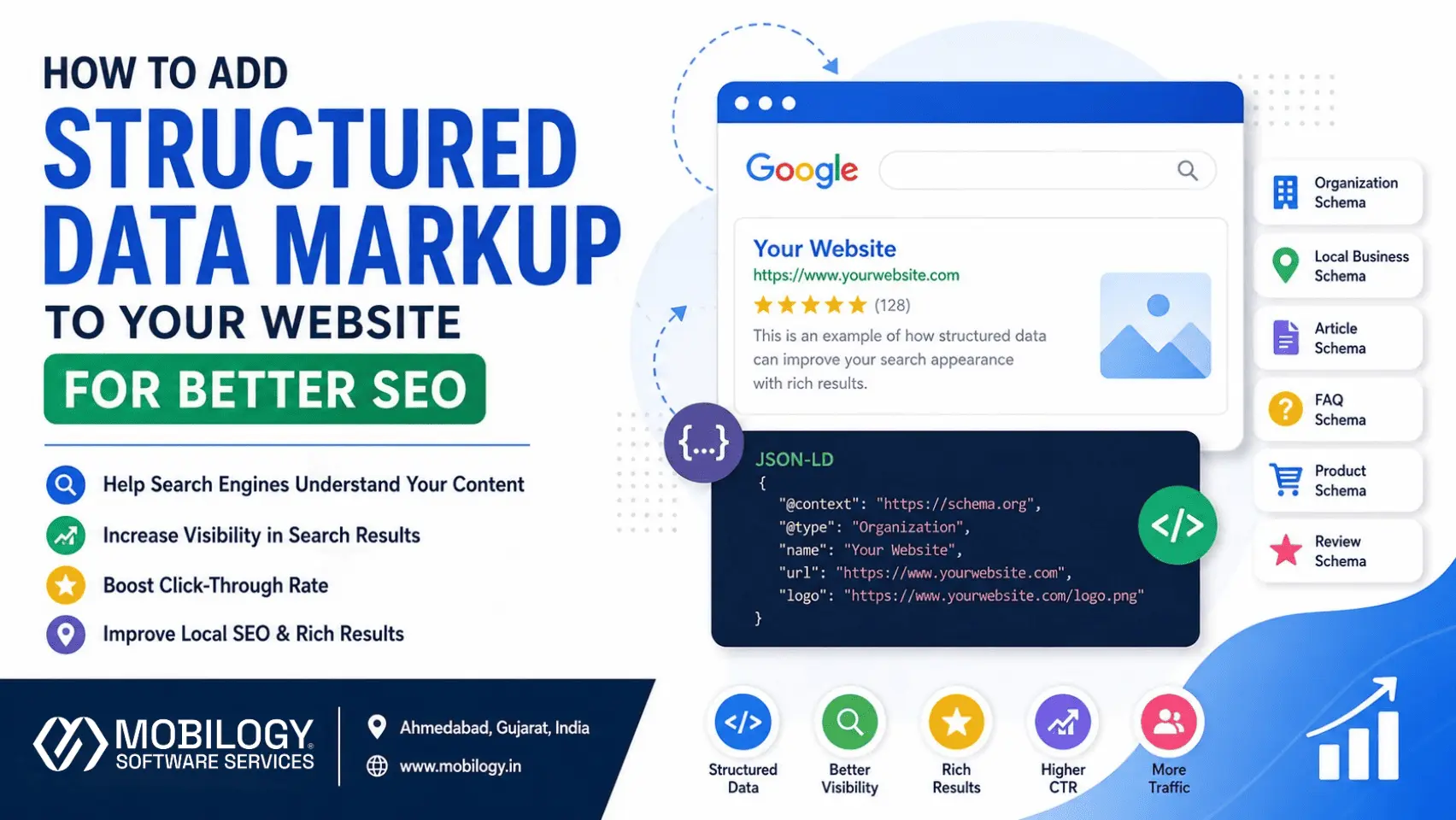
Search engine optimization is constantly evolving, and simply creating high-quality content is no longer enough to secure top rankings. Search engines like Google now focus on understanding the meaning and context of your website content rather than just matching keywords. This is where Structured Data Markup becomes one of the most valuable SEO techniques.
At Mobilogy Software Services LLP, we help businesses implement advanced SEO strategies that improve search visibility, increase click-through rates, and enhance user experience. Adding Structured Data Markup is one of the most effective ways to help search engines better understand your website while increasing your chances of earning rich search results.
Whether you run an eCommerce store, business website, healthcare portal, educational website, or local service business, implementing Schema Markup correctly can significantly improve your SEO performance.
What is Structured Data Markup?
Structured Data Markup is a standardized code added to your website that helps search engines understand your content more accurately.
Instead of simply reading text, Google can identify:
- Business information
- Products
- Services
- Reviews
- FAQs
- Articles
- Events
- Recipes
- Videos
- Locations
- Authors
- Organization details
Structured Data follows the Schema.org vocabulary, which is supported by Google, Bing, Yahoo, and Yandex.
Think of it as giving search engines a detailed roadmap of your content rather than asking them to guess what each page represents.
Why Structured Data Matters for SEO
Many website owners believe Structured Data directly improves rankings. While it is not a direct ranking factor, it provides several SEO benefits that indirectly improve performance.
Some major advantages include:
- Better understanding of your content by search engines
- Eligibility for Google Rich Results
- Higher Click-Through Rate (CTR)
- Improved visibility in Search Engine Results Pages (SERPs)
- Better indexing
- Enhanced Local SEO
- Voice Search optimization
- AI Search optimization
- Increased trust among users
As Google increasingly relies on AI-powered search experiences, structured content becomes even more valuable.
Types of Structured Data Every Website Should Consider
Different websites require different Schema types depending on their business goals.
1. Organization Schema
Ideal for:
- Companies
- Agencies
- Startups
- Brands
This schema includes:
- Company name
- Logo
- Website
- Social profiles
- Contact information
For example, Mobilogy Software Services LLP can use Organization Schema to help search engines understand its digital marketing services and business identity.
2. Local Business Schema
One of the most important schemas for businesses targeting local customers.
It includes:
- Business address
- Phone number
- Opening hours
- Geo-location
- Business category
- Reviews
Businesses located in Ahmedabad, Gujarat, India can greatly benefit from Local Business Schema because it supports Local SEO efforts.
3. Article Schema
Perfect for blogs.
Benefits include:
- Better article indexing
- Author information
- Publish date
- Updated date
- Featured image
- Breadcrumb display
Every blog published on www.mobilogy.in should ideally include Article Schema.
4. FAQ Schema
FAQ Schema helps display questions directly in search results (when eligible).
It improves:
- User engagement
- Search visibility
- Topical authority
Only use FAQ Schema for genuine question-and-answer sections visible on the page.
5. Breadcrumb Schema
Breadcrumbs help Google understand website hierarchy.
Example:
Home → SEO Services → Technical SEO → Structured Data Guide
Benefits include:
- Better navigation
- Improved crawling
- Cleaner search snippets
6. Product Schema
Essential for eCommerce websites.
Includes:
- Product name
- Price
- Currency
- Availability
- Reviews
- Ratings
- Brand
Google can display rich product information directly in search results.
7. Service Schema
Ideal for agencies and service providers.
Examples include:
- SEO Services
- Website Development
- PPC Advertising
- Mobile App Development
- AI SEO Optimization
This helps search engines clearly identify the services offered.
8. Review Schema
Review Schema highlights:
- Customer ratings
- Testimonials
- Overall score
Authentic reviews can improve trust and encourage more clicks from search results.
JSON-LD: Google’s Preferred Structured Data Format
Google recommends implementing Structured Data using JSON-LD (JavaScript Object Notation for Linked Data).
Advantages include:
- Easy to implement
- Doesn’t interfere with website design
- Easier to maintain
- Cleaner code
- Preferred by Google
Compared to Microdata and RDFa, JSON-LD is generally the best choice for modern websites.
How to Add Structured Data to Your Website
Implementing Schema Markup involves several important steps.
Step 1: Identify the Page Type
Different pages require different schema.
Examples:
- Homepage → Organization Schema
- Contact Page → Local Business Schema
- Blog → Article Schema
- Service Page → Service Schema
- Product Page → Product Schema
Step 2: Select the Correct Schema
Avoid adding unnecessary schema.
For example:
A blog should not use Product Schema.
A service page should not use Recipe Schema.
Always match the schema to the page content.
Step 3: Generate Schema Code
You can create Schema using:
- Google-supported generators
- Schema.org documentation
- SEO plugins
- Custom JSON-LD coding
Many WordPress SEO plugins also generate basic structured data automatically, but manual customization often provides better accuracy.
Step 4: Add JSON-LD Code
The code is typically placed within the <head> section or inserted using an SEO plugin.
Ensure:
- No syntax errors
- Correct field values
- Updated URLs
- Accurate business information
Step 5: Validate the Markup
Never publish Schema without testing it.
Validation helps identify:
- Missing fields
- Invalid properties
- Formatting issues
- Required attributes
Proper validation ensures Google can process your markup successfully.
Best Practices for Structured Data Implementation
Following Google’s recommendations is essential for long-term SEO success.
Use Accurate Information
Never include fake:
- Reviews
- Ratings
- Prices
- Addresses
- Contact details
Google may ignore or penalize misleading structured data.
Match Visible Content
Everything included in Schema should also appear on the webpage.
Hidden or misleading content violates Google’s guidelines.
Keep Schema Updated
Update structured data whenever:
- Services change
- Business hours change
- Contact details change
- Products become unavailable
- Blog content is revised
Outdated schema reduces accuracy.
Avoid Duplicate Schema
Using multiple conflicting schemas on the same page can confuse search engines.
Instead:
- Combine compatible schema types carefully.
- Ensure each page has one primary purpose.
Use Canonical URLs
Schema should reference the canonical version of each page.
This helps avoid indexing confusion and supports stronger SEO signals.
Common Structured Data Mistakes
Many businesses implement Schema incorrectly.
Avoid these mistakes:
- Using the wrong Schema type
- Missing required fields
- Invalid JSON syntax
- Fake review ratings
- Duplicate Organization Schema
- Broken URLs
- Missing images
- Incorrect dates
- Outdated information
- Forgetting validation
Fixing these issues improves the likelihood of earning rich search results.
Structured Data and AI-Powered Search
Search engines are becoming increasingly AI-driven. Features such as AI-generated summaries and conversational search rely on clearly structured information.
Implementing Structured Data Markup can help AI systems better interpret:
- Business details
- Services
- Products
- Authors
- Articles
- FAQs
- Reviews
This strengthens your website’s readiness for the future of search.
Structured Data for Local SEO
Local businesses should prioritize Structured Data because it reinforces location-specific signals.
Key elements include:
- Business Name
- Address
- Phone Number
- Website
- Opening Hours
- Geo Coordinates
- Service Area
- Customer Reviews
When combined with an optimized Google Business Profile, Local Business Schema can enhance your visibility in local search results.
Structured Data for Digital Marketing Agencies
Digital marketing agencies can implement multiple Schema types across their websites.
Examples include:
- Organization Schema
- Local Business Schema
- Service Schema
- Article Schema
- FAQ Schema
- Breadcrumb Schema
- Review Schema
This comprehensive approach helps search engines understand the full scope of the agency’s expertise.
How Structured Data Improves Click-Through Rate
Rich results often include:
- Ratings
- Images
- Breadcrumbs
- FAQs
- Business information
- Product details
These enhanced listings occupy more space in search results, making them more attractive to users.
As a result, websites with well-implemented structured data frequently experience higher organic click-through rates compared to standard search listings.
Measuring the Impact of Structured Data
After implementing Schema, monitor your website using tools such as:
- Google Search Console
- Google Analytics 4
- Rich Results Test
- Schema Validator
Track important metrics like:
- Organic traffic
- Click-through rate (CTR)
- Indexed pages
- Rich result eligibility
- Average search position
- User engagement
Regular monitoring allows you to refine your implementation and identify new opportunities.
Future Trends in Structured Data
As search engines continue to evolve, Structured Data will become even more important.
Emerging trends include:
- AI Search optimization
- Entity-based SEO
- Semantic Search
- Voice Search
- Zero-click search experiences
- Enhanced knowledge panels
- Rich shopping experiences
Businesses that invest in structured content today will be better positioned for tomorrow’s search landscape.
Why Choose Mobilogy Software Services LLP for Structured Data SEO?
Implementing Structured Data correctly requires both technical expertise and a clear understanding of SEO best practices.
At Mobilogy Software Services LLP, we help businesses across industries build search-friendly websites that align with Google’s latest recommendations. Based in Ahmedabad, Gujarat, India, our team specializes in:
- Technical SEO Audits
- Structured Data & Schema Markup Implementation
- AI SEO Optimization
- Local SEO Services
- On-Page SEO
- Website Development
- WordPress SEO
- Google Business Profile Optimization
- SEO Performance Monitoring
Our approach focuses on improving website visibility, enhancing search appearance, and creating a strong technical foundation for sustainable organic growth.
Structured Data Markup is no longer an optional SEO enhancement—it has become a fundamental part of modern website optimization. By helping search engines interpret your content accurately, Schema Markup increases your chances of appearing in rich results, improves click-through rates, strengthens local SEO, and prepares your website for AI-powered search experiences.
Whether you manage a business website, an online store, or a content-driven platform, implementing the right structured data can make a measurable difference in how your pages perform in search.
If you’re looking to implement Structured Data Markup, improve your Technical SEO, or optimize your website for the latest Google search features, Mobilogy Software Services LLP is ready to help. Visit www.mobilogy.in to explore our SEO solutions and discover how our team can build a stronger, search-friendly online presence for your business.


One Comment
Comments are closed.