Search is changing faster than at any point in the last decade. Instead of ten blue links, more and more Google results now open with an AI-generated answer — through AI Overviews, AI Mode and the Search Generative Experience (SGE). For businesses, this raises an urgent question: if AI answers the query directly, how do you still get seen, clicked and chosen?
At Mobilogy Software Services LLP, we help businesses adapt to this shift. Here is a practical 2026 guide to ranking — and getting cited — in Google’s AI-powered search.
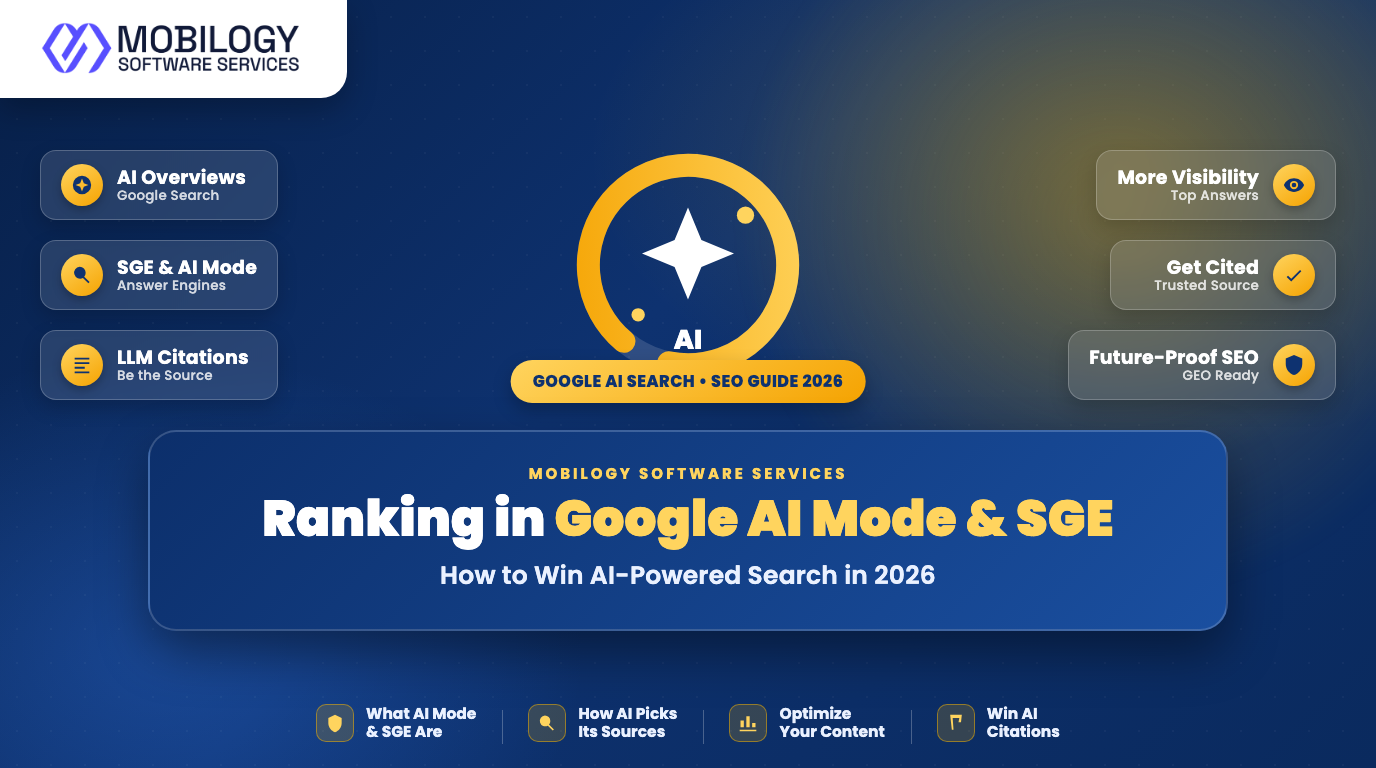
What Are Google AI Mode, AI Overviews and SGE?
These are all parts of Google’s move toward answer-first search:
- AI Overviews — an AI-written summary at the top of many results, pulling from multiple sources and linking to them.
- AI Mode — a conversational, chat-style search where users ask complex, multi-part questions and follow up naturally.
- SGE (Search Generative Experience) — the broader programme that introduced generative answers into Search.
Optimising for them is often called Generative Engine Optimization (GEO) or Answer Engine Optimization (AEO) — the evolution of SEO for an AI-first world.
Why This Matters for Your Business
When an AI Overview answers a question, the user may never scroll to the classic results. But the AI cites its sources — and being one of those cited sources puts your brand at the very top of the page as a trusted authority. Miss out, and a competitor becomes the answer instead. This is why AI-ready SEO is no longer optional.
How AI Search Chooses Its Sources
Generative engines do not reward keyword stuffing. They favour content that is genuinely helpful, well-structured and trustworthy. The signals that matter most:
1. Clear, direct answers
Content that answers a specific question clearly — ideally in the first sentence or two of a section — is far easier for an AI to extract and quote.
2. Strong E-E-A-T
Experience, Expertise, Authoritativeness and Trust. Real author information, accurate facts, citations and a credible brand all increase the odds of being used as a source.
3. Structured data and clean formatting
Schema markup, descriptive headings, lists, tables and FAQs help AI understand and reuse your content. See our guide on structured data and technical SEO.
4. Topical authority
Covering a topic thoroughly across multiple connected pages tells Google you are a genuine expert — not a one-off article.
How to Optimise for AI Mode & SGE in 2026
- Answer real questions: research the actual questions your customers ask and answer them directly, in plain language.
- Lead with the answer: put the key takeaway at the top of each section, then expand.
- Add FAQ sections with concise, self-contained answers and FAQ schema.
- Show real expertise: add author bios, credentials, data and original insight AI cannot easily replicate.
- Build topical clusters: link related articles and service pages together to demonstrate depth.
- Keep content fresh: update statistics and guidance regularly.
- Allow AI crawlers in your robots.txt (GPTBot, Google-Extended, PerplexityBot, ClaudeBot) if you want to appear in AI answers.
SEO Still Matters — It Is the Foundation
GEO does not replace SEO; it builds on it. Strong rankings, fast pages, clean technical SEO and quality backlinks are still the foundation AI draws from. If anything, the fundamentals matter more now, because AI tends to cite pages that already rank well. Pair this with a solid digital marketing strategy and you are positioned to win both classic and AI search.
How Mobilogy Can Help
As a forward-looking digital marketing company in Ahmedabad, Mobilogy builds AI-ready content and SEO strategies — from GEO-optimised articles and schema markup to topical authority planning — so your business gets found by both Google and the AI engines people now ask first.
Want to be the answer AI recommends? Talk to our team about an AI-SEO strategy for your business.
Frequently Asked Questions
What is the difference between SEO and GEO?
SEO optimises to rank in traditional search results; GEO (Generative Engine Optimization) optimises to be cited and surfaced inside AI-generated answers. The best strategy does both.
Will AI Overviews reduce my website traffic?
They can reduce clicks on informational queries, but being cited in the AI answer increases brand visibility and sends highly qualified traffic. Focus on being the source.
How do I get cited in Google AI Overviews?
Publish clear, authoritative, well-structured content that directly answers specific questions, back it with strong E-E-A-T and schema, and make sure the page already performs well in traditional search.
Do I still need traditional SEO in 2026?
Absolutely. AI engines largely draw from pages that already rank and show authority, so technical SEO, content quality and backlinks remain essential.