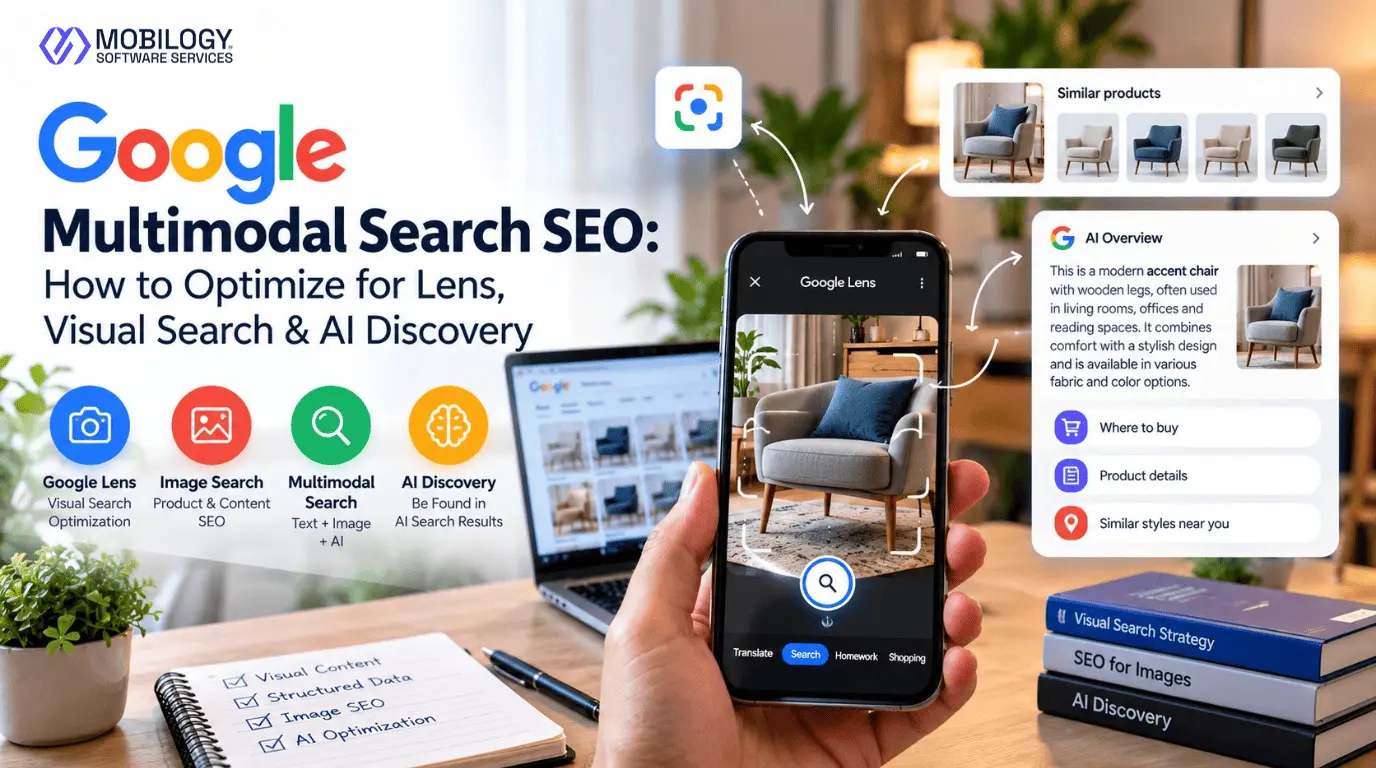
Google Search is moving beyond traditional text-based queries. Users can now search with images, smartphone cameras and visual interactions, creating new ways for websites and businesses to become discoverable. This shift is making Multimodal Search SEO an increasingly important part of modern search optimization.
In September 2026, Google introduced multimodal search performance reporting in Google Search Console, giving website owners more visibility into how their content performs when people search using visual inputs. The reporting includes searches through Google Lens, Circle to Search on Android, image uploads to Google Search and Chrome’s “Search this image” functionality.
For businesses, this means SEO can no longer focus only on keywords, rankings and written content. Images, visual context, page relevance, structured data and overall content quality can all contribute to how a website is discovered across evolving search experiences.
What Is Multimodal Search SEO?
Multimodal Search SEO is the process of optimizing website content so that it can be discovered and understood through different types of search inputs, including text, images and visual interactions.
Traditional search usually starts with a typed keyword such as:
- “digital marketing company Ahmedabad”
- “SEO services near me”
- “best SEO agency in Ahmedabad”
A multimodal search can begin with an image, camera input or another visual signal. Search engines then interpret the visual information and connect it with relevant web content.
This creates a broader optimization opportunity for businesses that publish:
- Product images
- Service-related graphics
- Infographics
- Location photographs
- Business photographs
- Original illustrations
- Charts and diagrams
- Screenshots
- Videos and visual content
The objective is not to optimize for a separate “magic” ranking factor. Instead, businesses should make their visual content useful, understandable, relevant and technically accessible.
Why Multimodal Search Matters
Search behavior is becoming increasingly diverse. People do not always want to describe something in words before searching for it.
For example, a user may:
- Take a photograph of a product.
- Upload an image to Google.
- Use Google Lens to identify an object.
- Use Circle to Search on an Android device.
- Search for additional information related to the visual result.
This creates additional discovery pathways for websites.
Google’s new Search Console reporting allows eligible site owners to analyze performance from these multimodal search experiences using a new multimodal search-type filter. Google says the data is being rolled out globally and can also be exported for analysis.
This is important because SEO measurement is gradually expanding beyond conventional text queries.
Google Lens and the New Visual Search Opportunity
Google Lens SEO is becoming more relevant as users increasingly use cameras and images to discover information.
Imagine a potential customer seeing a product, machine, building, design or service-related object and wanting to know more about it.
Instead of typing a long description, the user may simply use their camera.
For businesses, this means the images published on a website should have meaningful context.
A strong visual asset should ideally be supported by:
- Relevant surrounding content
- Descriptive image filenames
- Appropriate alternative text
- Clear page titles
- Relevant headings
- Useful captions where appropriate
- High-quality visual presentation
- A relevant page destination
The image should not exist in isolation. The surrounding webpage should help search engines and users understand what the image represents.
Circle to Search and Changing Search Behavior
Circle to Search allows users on supported Android devices to select something visible on their screen and search for information about it.
This represents a significant behavioral change.
Instead of asking:
“What is this?”
with a typed query, a user can visually select an object and search for it.
For businesses, this reinforces the importance of creating web pages where images and textual information work together.
For example, an architecture company could publish:
- Original project photographs
- Project descriptions
- Location information
- Service details
- Material information
- Relevant supporting content
Likewise, an e-commerce website can provide detailed product images alongside specifications and useful product information.
The broader principle is simple:
Make visual content meaningful within its webpage context.
How to Optimize Images for Multimodal Search
Image optimization remains an important component of Visual Search SEO.
Businesses should review how images are created, named, displayed and supported by page content.
1. Use Descriptive Image Filenames
Avoid meaningless filenames such as:
IMG_4829.jpg
Instead, use descriptive filenames that accurately identify the image.
For example:
digital-marketing-agency-ahmedabad.jpg
The filename should describe the actual image rather than being stuffed with unrelated keywords.
2. Write Useful Alt Text
Alt text helps describe an image when it cannot be visually accessed.
Good alt text should be:
- Accurate
- Concise
- Relevant
- Naturally descriptive
Avoid turning alt attributes into lists of keywords.
3. Provide Context Around Images
A relevant image placed on a relevant webpage provides stronger context than an isolated image.
For example, an image about local SEO services should appear on a page discussing local SEO rather than on an unrelated article.
4. Use High-Quality Original Images
Original photography, diagrams, illustrations and graphics can provide more value than repeatedly using generic stock images.
Businesses should prioritize visual assets that genuinely support the page’s purpose.
5. Optimize Image Performance
Large image files can negatively affect page performance and user experience.
Use appropriate:
- Image dimensions
- Compression
- Modern formats where suitable
- Responsive images
- Lazy loading where appropriate
Image quality should be maintained without unnecessarily increasing page weight.
Multimodal SEO Is More Than Image SEO
One common mistake is treating Multimodal Search SEO as simply another term for image optimization.
It is broader than that.
Multimodal search can involve multiple content formats working together:
Text + Images + Video + Structured Information + Page Context
For example, a service page could contain:
- A descriptive introduction
- Original service images
- Infographics
- Demonstration videos
- FAQs
- Relevant structured data
- Supporting internal links
Each element contributes to a clearer understanding of the page.
Google’s Search documentation also emphasizes that structured data can help Google understand webpage content, although structured data should accurately represent information visible on the page.
Structured Data and Visual Content
Structured data is not a shortcut for ranking in visual search.
However, appropriate structured data can help search engines understand specific types of content.
Depending on the website, businesses may use supported structured data such as:
- Article
- Breadcrumb
- Organization
- Local Business
- Product
- Video
- Image metadata
Google’s documentation lists image metadata among supported structured-data features and explains that structured data can help Google understand page content.
The important principle is accuracy.
Do not add structured data simply because you want to target a keyword. The markup should accurately describe the content available on the page.
Local Businesses Can Benefit From Visual Search
Local SEO is another area where multimodal search can create opportunities.
Consider someone visiting Ahmedabad and taking a photograph of a business, storefront, product or location.
Visual search can potentially become part of their discovery journey.
Local businesses should therefore maintain strong visual signals across their digital presence.
Useful assets can include:
- Authentic business photographs
- Office or storefront images
- Team photographs
- Product photographs
- Project photographs
- Service-related images
- Location-specific visual content
These assets should support an accurate and trustworthy representation of the business.
For a company targeting searches such as Digital Marketing Company in Ahmedabad, visual content can complement the site’s service pages, company information and local signals.
Google Search Console’s New Multimodal Reporting
One of the biggest developments for SEO professionals is not simply that multimodal search exists.
It is that Google is now providing more measurement data.
Google announced a new multimodal search type filter in Search Console’s Performance reports. The reporting covers multimodal searches including Lens, Circle to Search on Android, image uploads and Chrome’s “Search this image.”
This gives SEO teams an opportunity to investigate questions such as:
- Are users discovering our content through visual search?
- Which pages receive multimodal impressions?
- Which visual assets appear to attract engagement?
- Are certain pages performing better than others?
- How does multimodal traffic compare with other search traffic?
- Which visual content should we improve?
Google also allows the data to be exported for analysis in other tools.
This makes multimodal search increasingly measurable rather than purely theoretical.
How Businesses Can Build a Multimodal SEO Strategy
A practical strategy does not require rebuilding an entire website.
Start with the visual assets you already have.
Step 1: Audit Existing Images
Review important pages and identify:
- Missing alt text
- Generic filenames
- Low-quality images
- Oversized files
- Duplicate visuals
- Unclear image context
Step 2: Improve Important Commercial Pages
Focus first on pages that generate business value.
For example:
- Service pages
- Product pages
- Location pages
- Case studies
- Portfolio pages
- High-performing blog posts
Step 3: Create Original Visual Content
Develop useful visual assets that support your written content.
Examples include:
- Process diagrams
- Original infographics
- Comparison charts
- Product photographs
- Service illustrations
- Before-and-after project visuals
- Data visualizations
Step 4: Strengthen Page Context
Make sure the image, heading, paragraph and destination page all communicate the same subject.
Step 5: Monitor Search Console
Use Google’s new multimodal reporting where data is available and look for emerging patterns.
Step 6: Connect Visual Search With Business Goals
Do not measure success only through impressions.
Look at whether search visibility ultimately contributes to:
- Website engagement
- Enquiries
- Phone calls
- Form submissions
- Product discovery
- Bookings
- Sales opportunities
Common Multimodal SEO Mistakes
Businesses should avoid treating visual search as a keyword-stuffing exercise.
Common problems include:
Keyword-Stuffed Alt Text
Alt text should describe the image rather than contain an unnatural list of keywords.
Generic Stock Images Everywhere
Stock photography can be useful, but original visuals often provide stronger contextual value.
Images Without Context
An image on a page should support the subject of that page.
Extremely Large Images
High-resolution images that are unnecessarily large can affect performance.
Duplicate Visual Content
Using the same generic images across many pages can make the website’s visual content less distinctive.
Ignoring Mobile Experience
Many visual search interactions begin with mobile devices, making responsive design and mobile usability important.
Measuring Only Traditional Rankings
Multimodal discovery represents another layer of search visibility. Businesses should increasingly consider multiple forms of search performance.
The Future of Multimodal Search SEO
Search is moving toward a more integrated experience where users can combine different forms of information during one discovery journey.
A user might:
See → Capture → Search → Explore → Compare → Visit → Convert
This changes the role of SEO.
SEO professionals must think beyond individual keywords and consider how websites communicate information through multiple formats.
Visual content will not replace written content. Instead, the two can work together.
A strong webpage can combine:
Useful Text + Relevant Images + Clear Structure + Technical Accessibility + Strong User Experience
This approach is also consistent with Google’s broader emphasis on creating helpful, reliable, people-first content.
How Mobilogy Software Services LLP Can Help
Mobilogy Software Services LLP, located in Ahmedabad, Gujarat, India, provides digital marketing and SEO solutions designed to help businesses strengthen their online visibility.
As search behavior continues to evolve, businesses need SEO strategies that consider more than traditional keyword rankings.
Our approach can include:
- Technical SEO
- On-Page SEO
- Local SEO
- Content Strategy
- Image SEO
- Search Visibility Optimization
- Google Business Profile Optimization
- SEO Analytics and Performance Tracking
- Digital Marketing
- Website Optimization
For businesses preparing for the next generation of search, optimizing text, images, technical signals and overall content experience can create a stronger foundation for sustainable visibility.
Visit www.mobilogy.in to explore digital marketing and SEO solutions from Mobilogy Software Services LLP, Ahmedabad, Gujarat, India.
Frequently Asked Questions About Multimodal Search SEO
1. What is Multimodal Search SEO?
Multimodal Search SEO is the process of making website content discoverable and understandable across different search inputs, including text, images and visual search experiences.
2. What is Google Lens SEO?
Google Lens SEO refers to optimizing visual content and its surrounding webpage context so that images and related information can be better understood and discovered through Google Lens and visual search experiences.
3. Does image SEO still matter in 2026?
Yes. Images remain an important part of modern search experiences, and Google’s introduction of multimodal reporting in Search Console makes visual-search performance more measurable.
4. Does Google Search Console report Google Lens traffic?
Google announced multimodal reporting in Search Console that includes data from Lens, Circle to Search on Android, image uploads and Chrome’s “Search this image.”
5. How can businesses prepare for visual search?
Businesses should publish relevant original images, use descriptive filenames and useful alt text, provide strong webpage context, maintain technical performance and monitor available Search Console data.
6. Is Multimodal SEO the same as image SEO?
No. Image SEO is one component of multimodal optimization. Multimodal SEO considers how text, images, video and other content formats work together within modern search experiences.
7. Can local businesses benefit from visual search?
Yes. Businesses can strengthen their visual presence with authentic photographs, products, projects, locations and service-related images supported by relevant website and local business information.
8. Is there a special markup for Google Lens?
Businesses should not assume that a special “Lens SEO” markup is required. The stronger approach is to follow established SEO fundamentals, provide useful visual content and ensure search engines can access and understand the page.
The evolution of Google Search means businesses need to think beyond traditional text queries. Multimodal Search SEO introduces another important dimension of search visibility, where users can discover information through images, cameras and visual interactions.
Google’s September 2026 introduction of multimodal performance reporting in Search Console is an important development because businesses can now gain greater insight into how their content performs across visual search experiences.
The opportunity is not simply to “rank images.” It is to create webpages where useful text, original visual content, strong context, technical accessibility and a good user experience work together.
For businesses planning their SEO strategy in 2026 and beyond, visual discovery should become part of the broader search visibility strategy.
Mobilogy Software Services LLP helps businesses in Ahmedabad, Gujarat, India and beyond develop practical SEO and digital marketing strategies designed for an evolving search landscape.
Website: www.mobilogy.in
Location: Ahmedabad, Gujarat, India