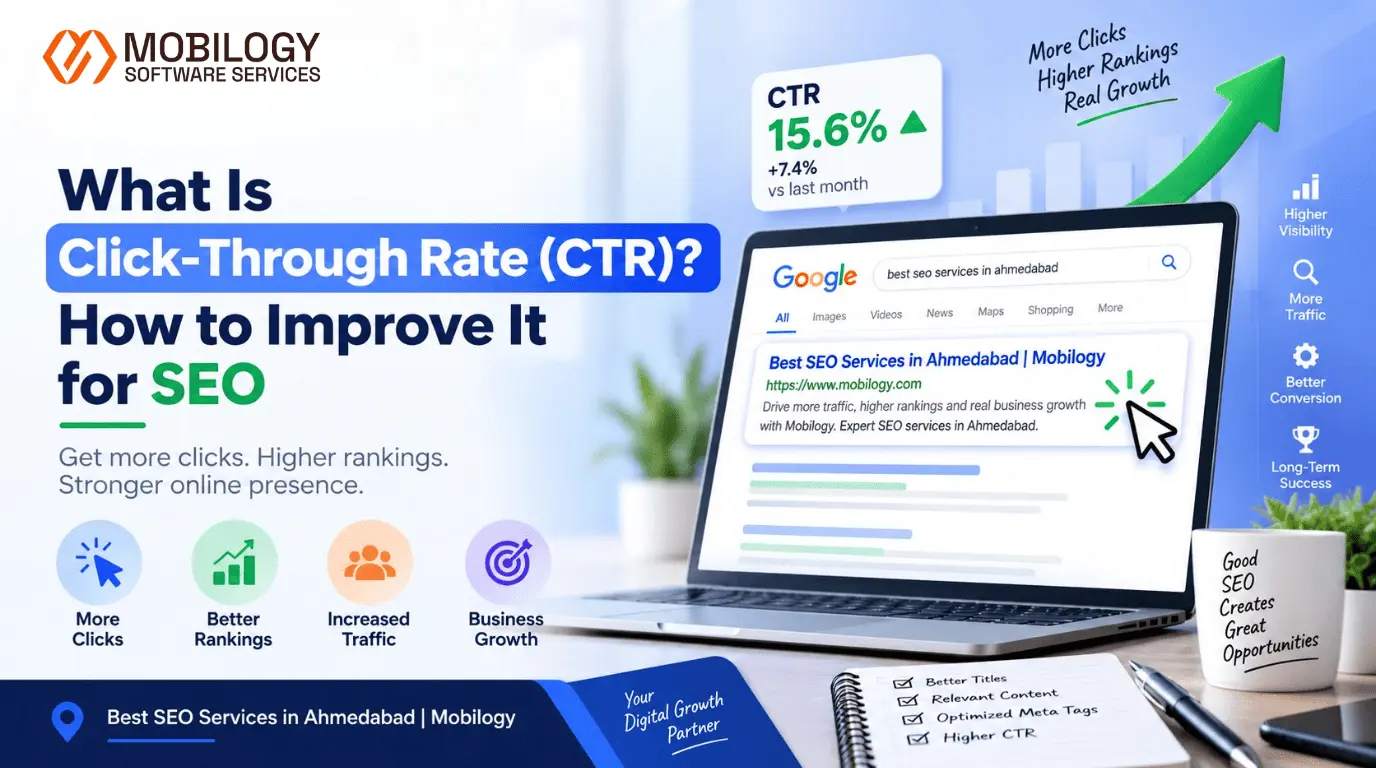
In modern SEO, ranking on Google is only one part of the equation. A website may appear in search results thousands of times, but if users do not click the listing, those impressions may not generate meaningful website traffic. This is where Click-Through Rate (CTR) becomes an important SEO performance metric.
CTR in SEO helps website owners understand how effectively their search result attracts users after it appears on a search engine results page (SERP). A strong CTR can indicate that the page title, search snippet, keyword relevance, and overall result presentation are appealing to the searcher’s intent.
For businesses competing in crowded markets such as digital marketing, SEO services, web development, PPC, and local SEO, improving organic CTR can help turn existing search visibility into more qualified visitors.
At Mobilogy Software Services LLP, Ahmedabad, Gujarat, India, we focus on practical SEO strategies that combine search visibility, useful content, user intent, and conversion-focused optimization.
What Is Click-Through Rate (CTR)?
Click-Through Rate (CTR) is the percentage of users who click a search result after seeing it.
The basic formula is:
CTR = (Clicks ÷ Impressions) × 100
For example, if a webpage receives 5,000 impressions in Google Search and generates 250 clicks:
CTR = (250 ÷ 5,000) × 100 = 5%
Google Search Console reports clicks, impressions, CTR, and average position as key Search performance metrics. Google defines CTR as clicks divided by impressions.
CTR therefore answers a simple but valuable question:
When people see my website in search results, how often do they choose it?
A high number of impressions with a low CTR may indicate an opportunity to improve the way the result communicates relevance to searchers.
Why Is CTR Important for SEO?
CTR matters because search visibility does not automatically produce website traffic.
Imagine two businesses ranking for the same type of keyword. Both receive similar impressions, but one search result has a more relevant title, clearer value proposition, and stronger alignment with user intent.
Users are more likely to click the result that immediately communicates what they can expect.
Improving CTR can help you make better use of rankings you already have.
Important benefits include:
- More organic traffic from existing search impressions
- Better alignment between search intent and page messaging
- Greater visibility for important landing pages
- More opportunities to generate leads and enquiries
- Improved understanding of audience search behaviour
- Better identification of underperforming pages
- Stronger optimization of titles and search snippets
- More effective SEO content planning
However, CTR should not be treated as a standalone SEO target. A high CTR is useful only when the page actually satisfies the visitor after the click.
CTR vs Impressions vs Clicks vs Average Position
These four metrics are closely related but measure different aspects of search performance.
Impressions
An impression means your website appeared in a Google Search result according to Search Console’s measurement rules.
More impressions generally mean your pages are being exposed to more searches, but impressions alone do not guarantee traffic.
Clicks
A click occurs when a user selects a search result that leads to your website.
Clicks are closer to actual search traffic than impressions.
CTR
CTR shows the percentage of impressions that resulted in clicks.
For example:
- 10,000 impressions
- 400 clicks
- 4% CTR
Average Position
Average position represents the average position of your site’s topmost result across the impressions included in the report. It should be interpreted carefully because search results vary by query, device, location, and other factors.
This means you should avoid judging SEO performance using average position alone.
Google itself recommends looking at trends in impressions and clicks alongside position rather than treating position as the only performance indicator.
What Is a Good SEO CTR?
There is no single perfect CTR for SEO.
CTR can vary substantially depending on:
- Search position
- Search intent
- Keyword type
- Industry
- Brand recognition
- Device
- SERP features
- Search competition
- Query length
- Location
- Type of content
- Presence of advertisements
- Rich search features
- Branded versus non-branded searches
For this reason, comparing your CTR against a generic industry benchmark can sometimes produce misleading conclusions.
Instead, establish your own baseline.
For example, if a page consistently receives 2.5% CTR and later reaches 4%, that improvement can be meaningful even if another website reports a much higher percentage.
The better approach is to identify high-impression, low-CTR opportunities within your own Search Console data.
How to Improve CTR for SEO
1. Write Better SEO Title Tags
The title is one of the most visible elements of a traditional Google search result.
A good SEO title tag should communicate relevance quickly.
Instead of creating a generic title such as:
SEO Services | Mobilogy
you could make the intent clearer:
SEO Services in Ahmedabad to Grow Organic Traffic
The better title should accurately represent the page rather than simply inserting keywords.
When writing title tags:
- Put the primary topic naturally near the beginning where appropriate
- Communicate a clear benefit
- Avoid unnecessary keyword repetition
- Make the title specific
- Match the actual page content
- Avoid misleading promises
- Consider the user’s search intent
The goal is not to write a title solely for search engines. Write it for the person deciding which result to click.
2. Improve Meta Descriptions
A meta description can help communicate what users can expect from a webpage.
A useful description should:
- Explain the page’s value
- Include relevant terms naturally
- Match the search intent
- Encourage an informed click
- Avoid keyword stuffing
- Give users a reason to continue
Do not treat the meta description as a collection of keywords.
Instead, think of it as a short marketing message for the search result.
Google may generate or modify search-result snippets depending on the query and page content, so you should not assume your exact meta description will always appear. Nevertheless, writing a useful description remains a sensible on-page optimization practice.
3. Match Search Intent More Closely
Search intent optimization is one of the most important ways to improve organic CTR.
Users may search for:
- Informational content
- Products
- Services
- Comparisons
- Reviews
- Local businesses
- Step-by-step instructions
- Pricing information
- Specific brands
A title that matches the user’s intended task is generally more compelling.
For example, someone searching:
how to improve website CTR
is probably looking for practical instructions.
A result titled:
CTR: Definition
may be less compelling than:
How to Improve Website CTR: 10 Practical SEO Strategies
The second title communicates a more direct match with the likely intent.
4. Use Specific Numbers Carefully
Numbers can make titles more concrete.
Examples include:
- 7 Ways to Improve Organic CTR
- 10 SEO Title Tag Strategies
- 5 CTR Mistakes That Reduce Search Traffic
However, numbers should only be used when they accurately reflect the content.
Avoid creating artificial list headlines simply to attract clicks.
The objective is qualified clicks, not misleading clicks.
5. Optimize for Long-Tail Keywords
Long-tail keywords often reveal a more specific search need.
Instead of targeting only:
SEO
you may target phrases such as:
SEO services for small businesses in Ahmedabad
or:
how to improve organic CTR in Google Search
Long-tail queries can help you create more specific titles and content.
When the search result clearly addresses the exact problem, users may be more likely to select it.
6. Improve Content-to-Title Relevance
One of the biggest mistakes in CTR optimization is creating a highly attractive title that the page does not satisfy.
Suppose the title says:
Complete SEO Audit Checklist for 2026
but the page contains only a short overview.
Users may click, discover that the promised information is missing, and leave.
Instead, make sure the page delivers exactly what the title suggests.
This creates a better relationship between:
Search query → Search result → Website content → User satisfaction
CTR optimization should therefore be connected to content quality and search intent, not treated as click generation alone.
7. Optimize Pages With High Impressions but Low CTR
This is one of the most practical SEO opportunities available through Google Search Console.
Google recommends using the Performance report to identify pages with low CTR and reviewing whether their titles, descriptions, or content better match the queries generating impressions.
Look for pages that have:
- High impressions
- Reasonable average positions
- Low CTR
- Relevant search queries
These pages already have visibility.
Instead of immediately creating another article, consider improving the existing search result first.
Possible changes include:
- Rewriting the title
- Improving the meta description
- Clarifying the page’s primary benefit
- Better matching search intent
- Updating outdated information
- Strengthening topical coverage
- Improving internal linking
- Adding useful supporting sections
8. Separate Branded and Non-Branded CTR
Branded searches and non-branded searches behave differently.
Someone searching for your company name may already know your business. Someone searching for a generic service may be discovering your company for the first time.
Google Search Console provides a branded/non-branded query filter in supported Performance reports, allowing marketers to analyze these groups separately.
For example:
Branded:
- Mobilogy Software Services
- Mobilogy SEO company
Non-branded:
- SEO company Ahmedabad
- digital marketing company Ahmedabad
- SEO services Ahmedabad
Comparing these segments can provide a clearer picture of brand awareness versus new organic discovery.
9. Optimize for Mobile Search
A large portion of modern search activity happens on mobile devices.
Mobile users often scan results quickly, which makes concise and relevant search-result messaging important.
When optimizing pages, consider:
- Shorter, meaningful titles
- Clear page headings
- Fast-loading pages
- Easy mobile navigation
- Readable content
- Strong above-the-fold messaging
- Responsive design
- Clear calls to action
CTR optimization should be considered alongside the complete mobile search experience.
10. Use Structured Data Where Appropriate
Structured data helps search engines understand specific types of content.
Depending on the page, relevant structured data may support eligible search-result enhancements.
Examples can include:
- Article
- Breadcrumb
- Organization
- Local business
- Product
- Event
- FAQ where applicable
Structured data does not guarantee a particular rich result or higher CTR, but accurately implemented markup can help search engines interpret eligible content.
Always use structured data that genuinely represents the page rather than adding markup simply to gain a visual enhancement.
CTR and AI Search in 2026
Search behaviour continues to evolve as users interact with traditional results, AI-generated search experiences, rich results, and other search features.
Google Search Console now reports interactions involving AI Overviews under its Search performance measurement rules. Google states that a click on an external link from an AI Overview counts as a click, while standard impression rules apply.
This makes AI SEO, search visibility, and content relevance increasingly connected.
Businesses should therefore focus on creating content that is:
- Original
- Helpful
- Well structured
- Easy to understand
- Supported by relevant information
- Closely aligned with user intent
- Demonstrably useful for the target audience
Instead of optimizing only for a traditional blue-link position, businesses should think about how their content can remain useful across changing search experiences.
How to Find CTR Opportunities in Google Search Console
You can create a practical CTR improvement workflow using Google Search Console.
Step 1: Open the Performance Report
Review:
- Total clicks
- Total impressions
- Average CTR
- Average position
Step 2: Review Queries
Look for queries generating substantial impressions.
Step 3: Identify Low-CTR Opportunities
Find searches where your page receives visibility but comparatively few clicks.
Step 4: Check the Page
Review whether the title and description clearly communicate the page’s value.
Step 5: Compare Search Intent
Ask:
Does this page provide exactly what someone searching this query expects?
Step 6: Update Carefully
Change one major element at a time where practical so you can better understand performance changes.
Step 7: Monitor Trends
Do not judge performance immediately after making an update.
Compare suitable time periods and monitor:
- Impressions
- Clicks
- CTR
- Average position
- Query changes
- Organic conversions
Search Console’s Performance report can be grouped by queries, pages, countries, and other dimensions, making it useful for identifying specific SEO opportunities.
Common CTR Mistakes to Avoid
CTR optimization can become counterproductive when it focuses only on clicks.
Avoid:
- Keyword stuffing in titles
- Clickbait headlines
- Promising information that the page does not contain
- Repeating the same title across multiple pages
- Writing generic meta descriptions
- Ignoring search intent
- Changing successful pages without evidence
- Comparing CTR without considering ranking position
- Focusing only on one keyword
- Treating CTR as the only SEO KPI
A strong SEO strategy should connect CTR with engagement, qualified traffic, leads, conversions, and business outcomes.
CTR Should Be Measured With Business Goals
A click is not necessarily a conversion.
For a business website, the real objective may be:
Search visibility → Click → Relevant visitor → Engagement → Enquiry → Lead → Customer
Therefore, improving CTR should support the larger SEO strategy.
For example, a service page that receives 1,000 impressions and 50 highly relevant visitors may be more valuable than a page receiving 10,000 impressions and 100 visitors who have no intention of purchasing.
This is why qualified organic traffic is more meaningful than traffic volume alone.
Final Thoughts
Click-Through Rate (CTR) is an important metric for understanding how effectively your website attracts visitors from search results. It connects search visibility with actual clicks and can reveal valuable opportunities for SEO improvement.
The most effective CTR strategy is not about writing sensational titles or chasing an arbitrary percentage. It is about creating a strong connection between the search query, search intent, title, snippet, content, and user expectation.
Start by analyzing pages with strong impressions but weak CTR. Improve their titles, descriptions, content relevance, and search-intent alignment. Then monitor performance through Google Search Console and connect organic traffic with meaningful business outcomes.
For businesses in Ahmedabad and across India, Mobilogy Software Services LLP provides digital marketing and SEO solutions designed to improve online visibility, attract relevant audiences, and support sustainable organic growth.
Website: www.mobilogy.in
Company: Mobilogy Software Services LLP
Location: Ahmedabad, Gujarat, India
Frequently Asked Questions About SEO CTR
1. What is a good CTR for SEO?
There is no universal good CTR for SEO. CTR depends on search position, keyword intent, industry, device, SERP features, brand awareness, and competition. The best approach is to establish a baseline for your own website and work toward improving relevant pages over time.
2. Does a higher CTR improve Google rankings?
CTR should not be treated as a simple ranking-factor formula. A higher CTR means more users are choosing your result from the impressions it receives, but SEO performance depends on many factors. Focus on improving relevance, helpfulness, technical SEO, content quality, and the overall search experience.
3. How can I improve organic CTR?
You can improve organic CTR by creating clearer title tags, useful meta descriptions, matching search intent, targeting relevant long-tail queries, improving content relevance, and analyzing high-impression/low-CTR pages in Google Search Console.
4. How do I check my website CTR?
You can check website CTR through the Google Search Console Performance report. The report provides clicks, impressions, CTR, and average position, along with query and page-level performance data.
5. Does CTR matter for AI search and modern SEO?
CTR remains useful for understanding how users interact with your content in Google Search. Search experiences are also evolving with AI Overviews and other search features. Google states that clicks on external links from AI Overviews are counted as clicks in Search Console, making it increasingly useful to monitor how your content performs across changing search experiences.