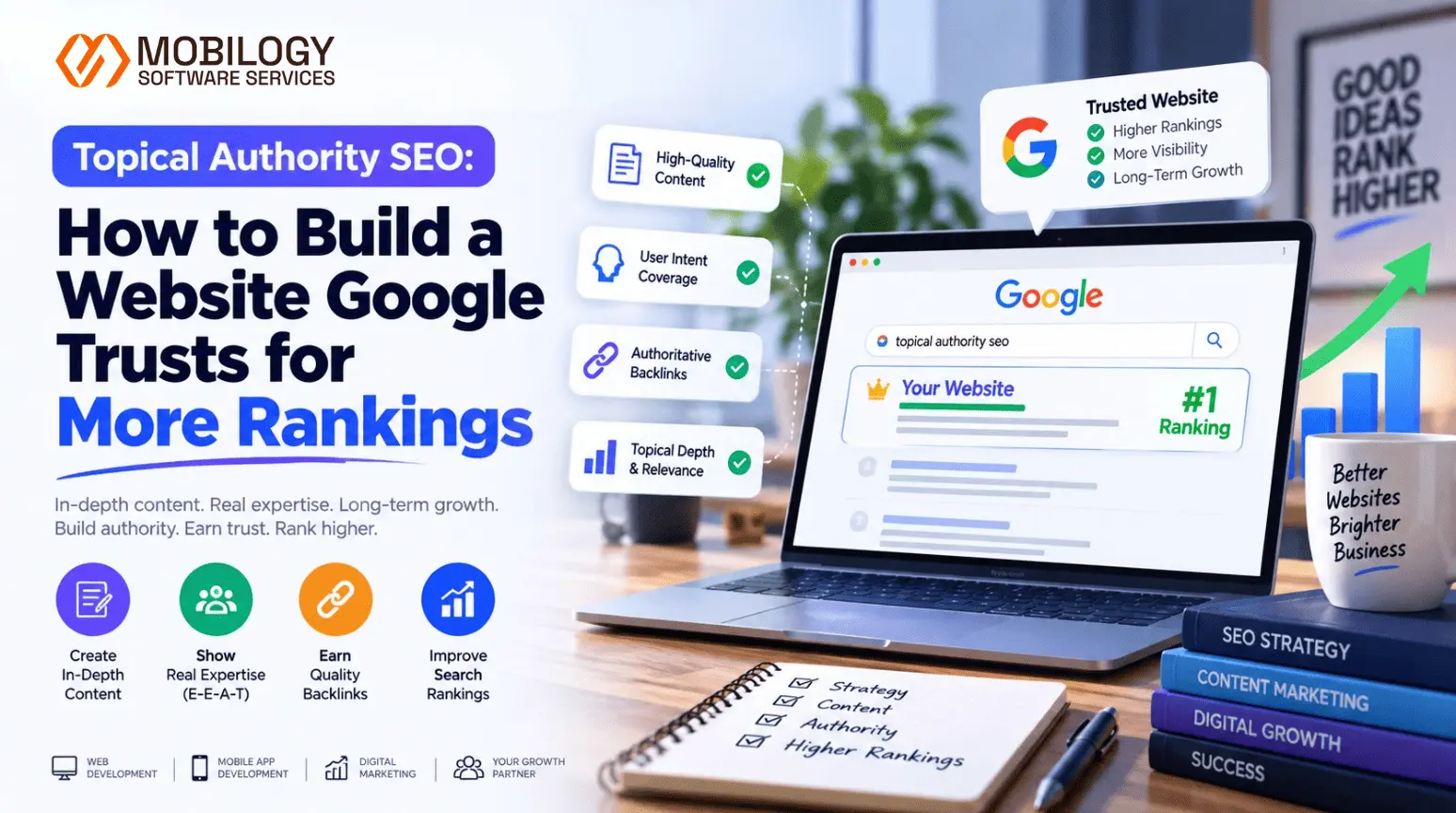
Search engines have become far more sophisticated than simply matching a webpage with a keyword. Today, a website needs to demonstrate relevance, depth, consistency, expertise, and useful coverage across an entire subject area. This is where Topical Authority SEO becomes an important part of a modern search strategy.
Instead of creating individual pages around disconnected keywords, businesses can build a structured collection of useful resources that comprehensively addresses the questions and needs of their target audience. This approach can strengthen topical relevance in SEO, improve internal relationships between related pages, and create a clearer understanding of what a website is genuinely knowledgeable about.
For businesses competing in Ahmedabad and across India, developing Website Authority is especially valuable in competitive industries where many websites publish similar services and information.
Google’s current guidance continues to emphasize useful, original, people-first content and warns against creating large amounts of unoriginal content primarily to manipulate rankings. Its 2026 guidance also confirms that SEO best practices remain relevant for Google’s generative AI search experiences.
What Is Topical Authority in SEO?
Topical Authority in SEO refers to the depth and breadth of useful content a website develops around a particular subject.
For example, imagine a digital marketing website that only publishes one article about SEO. It may target an important keyword, but it provides limited information about the broader subject.
Now imagine another website covering:
- Keyword research
- Search intent
- On-page SEO
- Technical SEO
- Content optimization
- Internal linking
- Local SEO
- Entity SEO
- Semantic SEO
- Topic clusters
- SEO analytics
- SEO content strategy
- AI search optimization
- SEO measurement
The second website demonstrates much broader Topical Relevance in SEO.
The objective isn’t simply to publish more pages. Each page should serve a genuine purpose and contribute useful information to the overall subject.
Why Topical Authority SEO Matters in Modern Search
Search engines increasingly understand relationships between concepts rather than relying only on exact keyword matches.
A search query about “SEO for small businesses,” for example, can relate to:
- Local search
- Google Business Profile
- Keyword research
- Service pages
- Location pages
- Reviews
- Content marketing
- Technical performance
- Conversion optimization
This creates an opportunity for businesses to develop a connected Topical Authority SEO Strategy rather than relying on one isolated article.
Google also states that structured data can help its systems understand page content and that search appearance can involve multiple content types and search features.
Key benefits include:
- Stronger topical coverage
- Better internal linking opportunities
- Improved content organization
- Greater relevance for related searches
- More opportunities to capture long-tail queries
- Stronger user journeys
- Better support for conversion-focused content
- A clearer relationship between services and informational content
However, topical authority does not guarantee rankings. Search visibility depends on many factors, including relevance, quality, technical accessibility, competition, user experience and Google’s ranking systems.
How to Build Topical Authority
Building topical authority is not about publishing hundreds of articles as quickly as possible. It requires planning.
Here is a practical framework for How to Build Topical Authority.
1. Choose Your Core Topic
Start with a subject directly related to your business.
For a digital marketing company, potential core topics include:
- SEO
- Local SEO
- PPC
- Content Marketing
- Social Media Marketing
- Web Development
- AI Search Optimization
Choose a subject where your company has genuine knowledge and services.
For example, SEO could become the main topic, while technical SEO, Local SEO, content SEO and keyword research become supporting subtopics.
This creates the foundation of your SEO Topical Authority.
2. Build Topic Clusters
Topic Clusters in SEO organize related content around a central subject.
A simple structure might look like:
Main Topic: SEO
Supporting topics:
- Keyword Research
- Technical SEO
- On-Page SEO
- Off-Page SEO
- Local SEO
- Content SEO
- Internal Linking
- SEO Analytics
Each supporting topic can then have more specific subtopics.
For example:
Local SEO
- Google Business Profile optimization
- Local keyword research
- Local citations
- Local reviews
- Local landing pages
- Google Maps visibility
This structure creates interconnected Content Clusters.
3. Understand Search Intent
Creating topical authority isn’t just about covering keywords.
You need to understand why someone is searching.
A user searching:
“What is technical SEO?”
probably wants educational information.
Someone searching:
“SEO company Ahmedabad”
may be researching service providers.
Someone searching:
“Hire dedicated SEO expert Ahmedabad”
has a stronger commercial intent.
Your SEO Content Strategy should address different stages of the customer journey.
Consider content for:
- Informational searches
- Commercial investigation
- Transactional searches
- Navigational searches
- Local searches
- Problem-solving searches
This helps your website become useful across multiple stages rather than targeting only purchase-oriented keywords.
Semantic SEO and Topical Relevance
Semantic SEO focuses on the meaning and relationships between words, topics and concepts.
For example, a page about “Local SEO” may naturally discuss:
- Google Business Profile
- Local search
- Maps
- Reviews
- NAP consistency
- Location keywords
- Local citations
- Service areas
These concepts help provide context around the main subject.
The goal is not to force every related keyword into the page.
Instead, write naturally and cover concepts that genuinely help readers understand the topic.
Avoid keyword stuffing
Repeating:
SEO Company Ahmedabad, Best SEO Company Ahmedabad, SEO Services Ahmedabad, Best SEO Services near me
again and again doesn’t create meaningful topical authority.
A stronger approach is to explain:
- What SEO services involve
- Which businesses need them
- How different SEO activities work together
- What businesses should measure
- How to evaluate SEO providers
- What realistic SEO growth looks like
This produces useful Content Authority rather than artificial keyword density.
Entity SEO: Connecting Businesses With Topics
Entity SEO focuses on clearly establishing people, businesses, organizations, products, locations and other identifiable entities and their relationships.
For a company such as Mobilogy Software Services LLP, relevant entities and concepts can include:
- Mobilogy Software Services LLP
- SEO
- Digital Marketing
- Local SEO
- PPC
- Content Marketing
- Ahmedabad
- Gujarat
- India
A strong website should communicate these relationships consistently.
For example, your About page, service pages, contact information, author information and relevant articles can collectively help establish the business context.
This doesn’t mean adding a company’s name everywhere. It means making your website’s information clear, consistent and useful.
Create Content That Deserves to Be Referenced
One of the most important parts of a Topical SEO Strategy is developing original information rather than rewriting what everyone else has already published.
Before creating an article, ask:
What useful information can this page provide that a reader cannot easily get from ten other generic articles?
Consider adding:
- Original examples
- Practical processes
- Expert explanations
- Industry-specific insights
- Data or research
- Comparisons
- Checklists
- Step-by-step instructions
- Frequently asked questions
- Real business scenarios
Google’s current spam guidance specifically warns against scaled content created primarily to manipulate rankings, including large quantities of unoriginal pages with little added value.
Therefore, publishing fewer but substantially more useful articles can be more sensible than producing large volumes of repetitive content.
Build Strong Internal Links
Internal linking is one of the most practical ways to connect your topical content.
Suppose you publish a pillar article about SEO.
You could naturally link to supporting articles about:
- Keyword research
- Technical SEO
- On-page optimization
- Local SEO
- Content strategy
- Internal linking
- SEO analytics
The links should help users discover relevant information.
A good internal linking structure should:
- Connect related pages
- Use descriptive anchor text
- Help users navigate deeper into a topic
- Support important service pages
- Connect informational content with commercial pages
- Avoid excessive or unnatural linking
The goal is not simply to increase the number of internal links. The goal is to create a logical information architecture.
Develop a Content Hierarchy
A topical website should have a clear hierarchy.
For example:
SEO
→ Technical SEO
→ On-Page SEO
→ Off-Page SEO
→ Local SEO
→ Content SEO
→ Keyword Research
→ SEO Analytics
Then each category can contain more specific resources.
This makes the website easier to navigate and helps visitors understand how individual topics relate to one another.
A well-organized structure can also make it easier for search engines to discover and interpret related pages.
Connect Informational Content With Business Services
A common mistake is creating informational articles that never connect with the company’s actual services.
For example, a digital marketing company can create useful educational content about:
“How Local SEO Works for Small Businesses”
Then, where genuinely relevant, the article can guide readers toward:
Local SEO Services
Similarly:
“Technical SEO Checklist for Business Websites”
can naturally connect to:
Technical SEO Services.
This creates a bridge between SEO Content Strategy and lead generation.
The content should educate first rather than turning every paragraph into a sales pitch.
Topical Authority and AI-Powered Search
Search is continuing to evolve through features such as AI Overviews and AI Mode.
Google’s 2026 documentation says its generative AI search features use information from multiple sources and emphasizes that existing SEO fundamentals remain relevant. Google has also published specific guidance about optimizing content for generative AI features while warning against misconceptions about special “AI SEO” tricks.
This makes comprehensive subject coverage increasingly useful.
When a website consistently explains a subject from different relevant perspectives, it creates a stronger information resource for users.
Businesses should focus on:
- Clear answers
- Original information
- Relevant supporting content
- Strong topical relationships
- Accurate business information
- Crawlable and indexable pages
- Good page experience
- Helpful multimedia where appropriate
Google’s page experience guidance also recommends considering Core Web Vitals, mobile usability, secure delivery, intrusive interstitials and overall usability rather than chasing a single technical score.
How Local Businesses Can Use Topical Authority
Topical authority is not limited to national brands.
A local business in Ahmedabad can build authority around its specific industry and location.
For example, a local digital marketing company can develop content around:
- SEO for Ahmedabad businesses
- Local SEO
- Google Business Profile
- SEO for small businesses
- E-commerce SEO
- Technical SEO
- Content marketing
- Search visibility
- Digital marketing strategies
This can support searches such as:
- Top SEO Company in Ahmedabad, Gujarat
- Search Engine Optimization Services Ahmedabad
- Best SEO Company near me
- Best SEO Agency near me
- Best SEO Services near me
- Hire Dedicated SEO Expert in Ahmedabad
- Best Local SEO Services near me
- Affordable SEO Services for your Business
- Top Digital Marketing Company in Ahmedabad India
These commercial keywords should be used naturally on relevant service and location pages rather than inserted repeatedly into unrelated informational articles.
Measuring Topical Authority SEO
There is no single Google metric called “Topical Authority Score” that guarantees rankings.
Instead, measure several indicators together.
Track:
- Organic clicks
- Organic impressions
- Search queries
- Non-branded keyword visibility
- Long-tail keyword growth
- Pages receiving organic traffic
- Internal link performance
- Engagement and conversions
- Leads generated from organic search
- Rankings for topic clusters
- Indexed pages
- Search Console trends
Google Search Console remains an important source for monitoring how your content performs in Search. Google has also expanded documentation around how social and video content can be analyzed through Search Console.
The most useful question is not:
“How many keywords do we rank for?”
Instead ask:
“Are our relevant pages attracting the right audience and contributing to business objectives?”
Common Topical Authority Mistakes
Avoid these mistakes when developing a Topical Authority SEO Strategy:
1. Publishing repetitive articles
Ten articles saying essentially the same thing do not automatically create authority.
2. Chasing every trending keyword
Not every keyword belongs on your website.
3. Ignoring search intent
A keyword may have multiple interpretations. Understand the user’s actual need before creating content.
4. Overusing exact-match keywords
Natural language and meaningful topic coverage are more useful than repetitive keyword insertion.
5. Creating disconnected content
Articles should have logical relationships where appropriate.
6. Ignoring existing content
Before creating another article, review your existing pages and identify gaps.
7. Creating content only for search engines
Your first audience should be people.
8. Using AI to mass-produce low-value pages
AI can support research and content workflows, but publishing large quantities of unoriginal material without meaningful value can create search spam risks.
Topical Authority as an SEO Strategy for Business Growth
A successful SEO Strategy for Business Growth should go beyond rankings.
A strong topical content ecosystem can help a company:
- Educate potential customers
- Answer questions before sales conversations
- Capture informational searches
- Build organic visibility
- Support service pages
- Strengthen internal navigation
- Generate qualified leads
- Build long-term content assets
For businesses looking for Affordable SEO Services for your Business, the objective should not simply be to publish the highest possible number of articles. The focus should be on creating a sustainable strategy where every important page has a clear purpose.
How Mobilogy Software Services LLP Can Help
Mobilogy Software Services LLP, based in Ahmedabad, Gujarat, India, provides digital marketing and SEO solutions designed to help businesses improve their online visibility.
A modern SEO campaign can combine:
- SEO strategy
- Keyword research
- Technical SEO
- On-page optimization
- Content strategy
- Local SEO
- Google Business Profile optimization
- Off-page SEO
- Competitor research
- SEO performance monitoring
- Search visibility analysis
Businesses searching for a Top SEO Company in Ahmedabad, Gujarat, Best SEO Agency near me, or Search Engine Optimization Services Ahmedabad can evaluate providers based on their strategy, transparency, experience and ability to connect SEO activities with measurable business objectives.
Visit www.mobilogy.in to learn more about Mobilogy Software Services LLP and its digital marketing solutions.
Frequently Asked Questions About Topical Authority SEO
1. What is Topical Authority SEO?
Topical Authority SEO is the practice of building comprehensive, useful website content around a subject and its related subtopics. It uses content organization, internal linking, semantic relationships and relevant expertise to create a strong topical resource.
2. How long does it take to build topical authority?
There is no fixed timeline. Results depend on the competitiveness of the subject, website history, content quality, technical condition, competition and publishing consistency. Topical authority should be viewed as a long-term SEO process rather than a short-term ranking tactic.
3. What are Topic Clusters in SEO?
Topic Clusters in SEO are groups of related content organized around a central subject. A main pillar page covers the broad topic while supporting pages address specific related questions or subtopics.
4. Is Semantic SEO the same as topical authority?
No. Semantic SEO focuses on meaning, concepts and relationships between terms and entities. Topical authority is broader and concerns how comprehensively and usefully a website covers a subject.
5. Does topical authority guarantee Google rankings?
No. Website Authority or topical coverage does not guarantee a particular ranking position. Google considers many signals and systems, including relevance, quality, technical accessibility and other factors.
6. Does topical authority matter for AI search?
Comprehensive, useful content can support visibility across modern search experiences, but there is no guaranteed formula for appearing in AI-generated results. Google says its generative AI search features continue to rely on web content and that established SEO best practices remain relevant.
7. Should every business create hundreds of SEO articles?
No. Publishing volume alone does not establish authority. Businesses should prioritize original, useful and relevant content that addresses genuine audience needs.
Topical Authority SEO is about building a website that provides meaningful depth around the subjects that matter to its audience and business.
Instead of treating every keyword as a separate target, businesses can create connected Content Clusters, develop Semantic SEO relationships, strengthen Entity SEO, improve internal linking and build a well-organized SEO Content Strategy.
For businesses in Ahmedabad and beyond, this approach can provide a sustainable foundation for organic search visibility while supporting broader digital marketing objectives.
The key principle is simple:
Don’t create more content just to rank. Create better-connected content that genuinely helps people understand and solve problems.
That is the foundation of a modern Topical SEO Strategy and a stronger long-term approach to search visibility.